Skip to content
Quick link: For a deeper product overview, see Circulation Heater.
Introduction
A circulation heater is a compact, inline electric package that heats moving liquids or gases to a precise temperature. Think of it as a controlled “hot section” inside your pipe. It delivers clean heat, fast response, and tight control while protecting elements and keeping the process safe.
What Is a Circulation Heater?
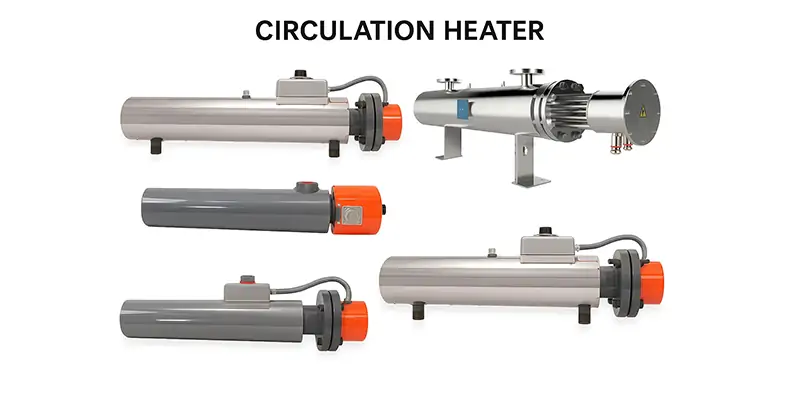
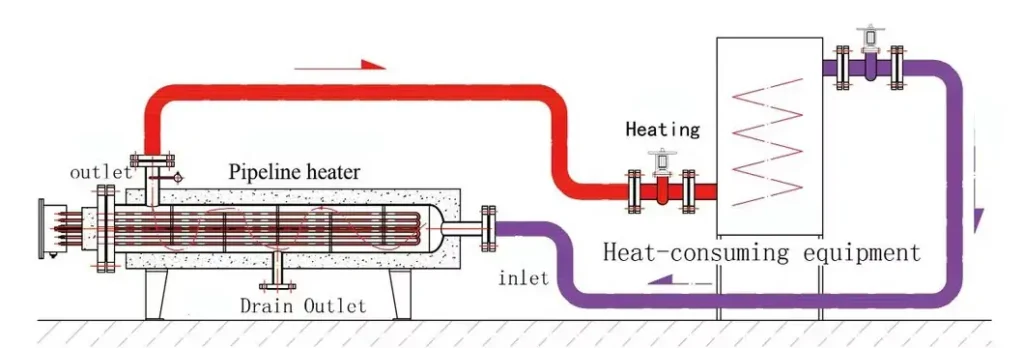
A circulation heater is an engineered assembly: a pressure-rated vessel with inlet and outlet nozzles, an electric heater bundle, temperature sensors, and a control panel. Fluid flows through the vessel past resistive elements that convert electrical energy to heat. Because flow is forced over the elements, heat transfer is efficient and uniform. Also called inline electric heaters or skid-mounted electric heaters, the goal is the same: controllable heat for a moving stream with minimal footprint and maximum safety.
How a Circulation Heater Works
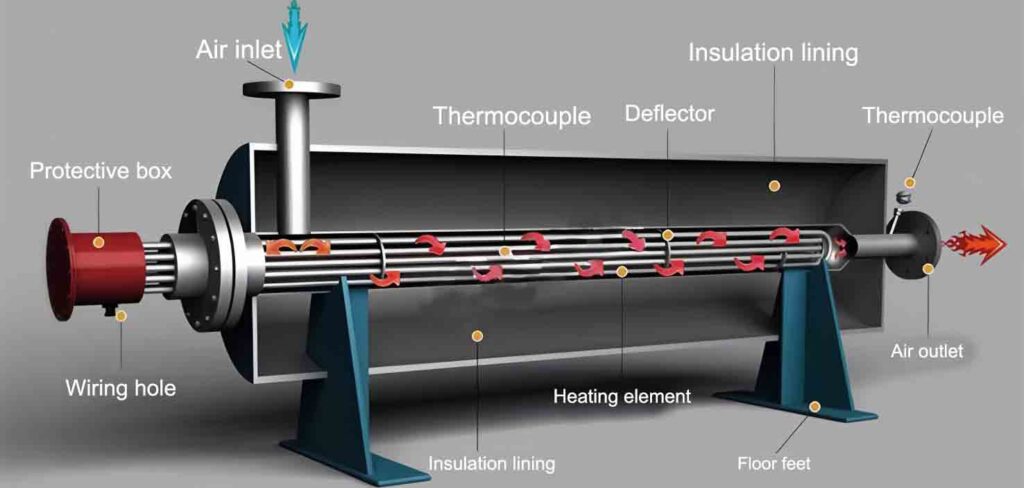
A circulation heater converts electrical power into thermal energy inside a sealed vessel.
Flow path and residence time
Fluid enters the inlet nozzle, passes over the heater bundle, and exits through the outlet. Baffles or straight-through designs set velocity and residence time. The aim is enough contact time to reach setpoint without overheating the element surface.
Resistive elements and watt density
Sheathed resistive elements (often stainless or high-nickel alloys) produce heat proportional to current. Watt density is power per unit element surface area. Match watt density to the fluid to avoid film boiling, coking, or scorching.
Heat transfer and ΔT control
Heat moves from the element sheath to the fluid by convection. Bulk rise depends on ΔT across the heater. Higher flow reduces outlet rise but improves film coefficients. Balance ΔT, velocity, and pressure drop to prevent hot spots.
Sensors, PID, and power switching
Thermocouples or RTDs measure outlet and sometimes skin temperature. A PID controller or PLC modulates power via SCRs or stages contactors. The loop trims power to hold setpoint despite changes in flow or inlet temperature.
Safety interlocks and trips
Independent safeties backstop control: high-temperature cutouts, flow or differential-pressure switches, low-level trips for tanks, ground-fault and insulation monitors, and emergency stop. If a hazard is detected, power is removed before damage.
Key Components
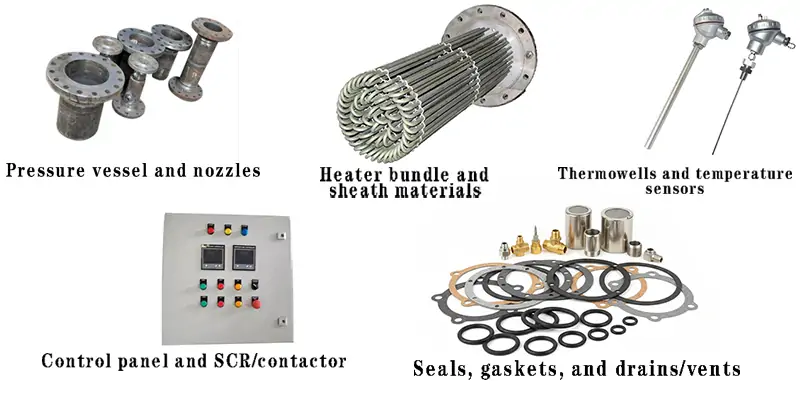
Pressure vessel and nozzles
An ASME/PED/CRN-stamped vessel contains the process. Flanged or threaded nozzles simplify tie-in. Orientation supports self-venting and drainability.
Heater bundle and sheath materials
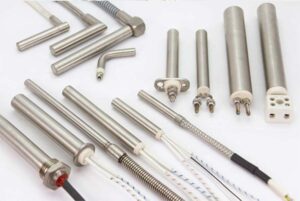
Bundles use tubular elements with welded plugs. Common sheaths: 304/316L SS, high-nickel alloys for chloride, amine, or sour service. Low watt density protects sensitive or viscous fluids.
Thermowells and temperature sensors
Thermowells protect RTDs/thermocouples from pressure and velocity. Typical locations: outlet bulk, mid-section monitoring, and high-limit skin sensors on elements or vessel.
Control panel and SCR/contactor
NEMA/IP-rated panels house the controller, power switching (SCRs for modulation, contactors for steps), breakers, fuses, and terminals. Options: PLC/HMI, data logging, remote I/O.
Insulation, supports, and skid
Mineral wool or aerogel insulation limits heat loss. Removable cladding aids maintenance. Skid bases add supports, drip trays, and lifting lugs.
Seals, gaskets, and drains/vents
Spiral-wound gaskets and quality O-rings prevent leaks. Dedicated drains and high-point vents enable hydrotests, blowdowns, and clean starts.
Types of Circulation Heaters
Liquid service: Water, thermal oils, glycols, solvents, caustics, lube oils; emphasize low surface temperature and metallurgy fit.
Gas service: Air, nitrogen, natural/fuel gas, CO₂, specialty gases; control velocity and watt density to avoid element overheating.
High-pressure/high-temperature: Thicker shells, forged nozzles, high-alloy sheaths for HP/HT, including supercritical or sour streams.
Hazardous area/explosion-proof: Certified builds with flameproof enclosures, purged panels, and zone/class compliance.
Sanitary/hygienic: 316L, electropolish, drainability, sanitary ferrules, and defined surface finish for food/beverage/biotech and CIP/SIP.
Industry Applications
Chemicals/solvents: Heat reactants, solvents, wash fluids while limiting degradation.
Oil & gas: Fuel-gas heating for turbines/engines, gentle amine reboil, stable glycol regeneration.
Power: Feedwater trim, nitrogen preheat for purges, lube oil viscosity control.
Food & beverage: CIP sanitation, uniform heating of syrups and edible oils.
Pharma/biotech: WFI, buffers, media with hygienic materials and documentation.
Aerospace/manufacturing: Test stands needing precise ramp/soak and fast response.

Sizing and Selection Criteria
Define process duty: Fluid, flow range, inlet/outlet temps, pressure, viscosity, fouling, cleanliness.
Calculate load:
Q = m · Cp · ΔTplus startup and heat-loss margins.Watt density and velocity: Keep velocity high enough to sweep heat, low enough to control DP/erosion.
Materials/corrosion: Sheath, vessel, and gaskets suited to chemistry and temperature; add corrosion allowance and assess chloride SCC, H₂S, amines.
Pressure rating/codes: Size to ASME/PED with defined test pressure and nameplate limits.
Electrical service: Voltage, phase, SCCR, panel space; choose SCR vs staged contactors considering harmonics.
Footprint/maintenance/spares: Clearance for bundle pull, sensor access, wiring; plan spare bundles, gaskets, instruments.
Controls and Safety
Control modes: On/off staging is simple; SCR gives smooth modulation and wide turndown.
Sensors: Primary RTD for control; independent high-limit sensors on outlet or element sheath.
Interlocks: Flow or DP trips, high-temp cutouts, and overpressure protection.
Ground-fault/insulation monitoring: Detect leakage and declining insulation resistance early.
SIL and proof tests: Define target SIL, voting, proof-test interval, response times, and bypass procedures.
Installation and Commissioning
Piping: Correct flow direction, proper supports to avoid nozzle loads.
Electrical/grounding: Follow codes for trays, glands, bonding; separate power and signals.
Hydro/pneumatic tests: Pressure-test to code; verify gasket seating and flange torque.
Loop checks/tuning: Verify polarity, wiring, I/O; tune PID on stable flow; verify ramp/soak.
Handover: Deliver datasheets, drawings, wiring, test records, QA data book; train operators.

Operation and Maintenance
Start-up/shutdown: Purge, verify flow, then power; on shutdown, remove power, then cool with flow.
KPIs: Track ΔT, kW per unit flow, and DP; drift suggests fouling, scaling, or sensor error.
Cleaning/inspection: Chemical clean as needed; inspect for discoloration, pitting, hot spots.
Element replacement/torque: Use specified torque on terminals and studs; replace in matched sets.
Spare kits: Gaskets, O-rings, sensors, high-limit devices, and one heater bundle for critical lines.
Efficiency and Energy Management
Insulation: Insulate shell, nozzles, and piping to cut losses.
SCR modulation: Real-time trim reduces overshoot and cycling.
Power quality: Add reactors/filters if SCR harmonics affect upstream gear or instruments.
Heat recovery/setpoints: Recover heat upstream where practical; right-size setpoints.
Codes and Compliance
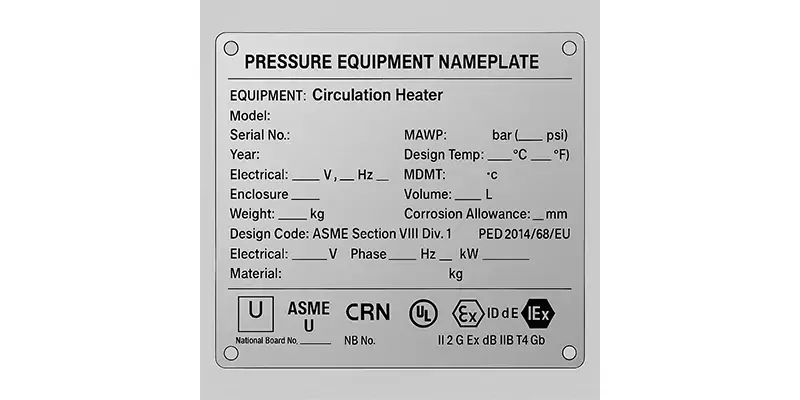
Pressure rules: ASME/PED/CRN with nameplates showing MAWP and design temperature.
Electrical: UL/CSA for panels and ATEX/IECEx for hazardous areas.
Sanitary standards: Meet 3-A or relevant specs; define surface roughness and weld finish.
QA records: Material traceability, welder quals, NDE, FAT/SAT, calibration certs.
Troubleshooting Guide
No heat/slow heat: Check power, fuses, contactors, SCR firing, sensors, flow, inlet temperature.
Nuisance trips/alarms: Investigate flow switch noise, RTD drift, PID tuning; verify grounding/shields.
Hot spots/coking/burnout: Lower watt density, raise velocity, reduce setpoint; confirm immersion and clean fouling.
Control oscillation: Retune PID, add output limits, increase filtering; hold flow constant while tuning.
Leaks/excess DP: Re-torque flanges hot; check gaskets; inspect internals for blockage or undersized nozzles.

Cost, Lead Time, and ROI
Cost drivers: kW, metallurgy, pressure rating, documentation, hazardous certs, control complexity.
Lead time: Material availability, code stamping, panel build, FAT scheduling; lock design early.
TCO/payback: Near-100% point-of-use efficiency and low maintenance; savings from tight control and no combustion losses.
Brief Case Snapshots
Fuel-gas conditioning: Heats and dries gas for turbines; fast modulation during load swings.
Lube-oil heating: Holds viscosity at start and steady load; reduces wear and energy loss.
CIP loop heating: Sanitary unit raises return flow to sanitize quickly; shortens cycle time.
Nitrogen gas heating: Preheats N₂ for purging to prevent condensation and improve drying.
When Not to Use One
Steam available with lower TCO: Existing clean steam and low cost per kWh-equivalent favors exchangers.
Severe fouling/slurries: Solids or sticky fouling insulate elements; consider jackets or external exchangers.
Extreme flows with tiny ΔT: High velocity and minimal ΔT can cause DP and control-resolution limits.
Incompatible chemistries/materials: If no suitable materials, use indirect heating or rethink approach.
How to Specify and Request a Quote
Datasheet fields: Fluid, min/max flow, inlet/outlet temps, pressure, viscosity, specific gravity, fouling, cleanliness.
Electrical one-line & P&ID: Voltage, phase, fault levels; include interlocks and alarms.
Area classification: Class/Division or Zone/Group, ambient range, enclosure ratings, purge/pressurization if used.
FAT/SAT & acceptance: Hydro/pneumatic, megger, function checks, loop tuning, documentation review; witness points and punch-list closure.
Glossary of Key Terms
Watt density: Power per element surface area.
ΔT: Temperature difference/rise.
SCR: Thyristor module for smooth power modulation.
RTD/Thermocouple: Temperature sensors.
MAWP: Maximum allowable working pressure.
SIL: Safety Integrity Level.
CIP/SIP: Clean-in-place/steam-in-place.
Ground fault: Leakage to earth.
Thermowell: Protective sensor sleeve.
Nameplate: Permanent code/rating marking.
Frequently Asked Questions
1) What fluids and gases can be heated?
Water, glycols, oils, solvents, caustics, amines, and gases like air, nitrogen, and fuel gas. Verify materials and watt density per service.
2) How do I choose watt density?
Base on fluid properties and velocity. Sensitive fluids and gases need lower values. Follow service-specific limits.
3) What turndown can SCR control achieve?
Often ~10:1 with stable sensing and proper element grouping. Minimum is limited by film velocity.
4) How do flow switches and DP sensors protect elements?
They confirm fluid movement. If flow drops, power trips before elements overheat.
5) What codes apply to the vessel and electrics?
ASME/PED/CRN for vessels; UL/CSA for electrical; ATEX/IECEx for hazardous; sanitary standards for hygienic builds.
6) How do I prevent coking and scaling?
Lower watt density, maintain velocity, set points only as high as needed, and clean based on KPIs.
7) What maintenance intervals are typical?
Quarterly visual checks, semiannual electrical tests/recalibration, annual element and gasket inspection; adjust to service.
8) How do I estimate electrical operating cost?kWh ≈ kW draw × hours. Multiply by tariff. Use logged power, not nameplate.
9) When is redundancy worth it?
Critical lines or no-downtime processes. Dual sensors/contactors or spare bundles improve availability.
10) What documentation is required for QA/audits?
Datasheets, drawings, MTRs, welder/NDE records, FAT/SAT reports, calibration certs, manuals, and nameplate photos.