Skip to content
1. What Is It?
You’ve definitely seen it before!
In daily life: the circle at the bottom of an electric kettle, the glowing red tubes in an oven, the heating tubes under a BBQ grill.
Appearance:
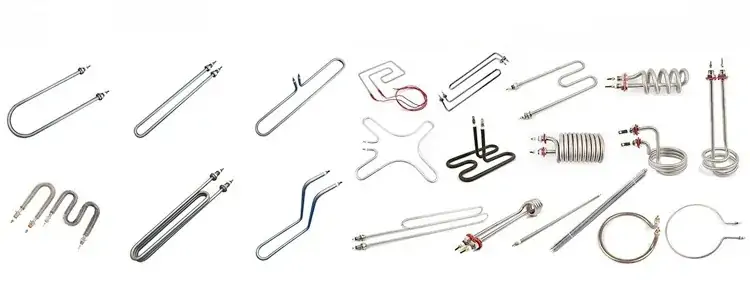
It’s usually a long metal tube with two screw terminals on both ends.
Biggest feature:
It can be bent freely.
It comes out of the factory straight, but can be shaped into U-shape, W-shape, coil shape, or even spiral form.
What’s inside it? (Same “sandwich” structure as cartridge heaters)
Core: Resistance wire (heat source)
Filling: Magnesium oxide powder (insulation + thermal conductivity)
Outer shell: Metal tube (protection)
2. Where Is It Used? (Air, Liquid, and Surface Heating)
Tubular heating elements can be customized in length and shape, so their applications fall into three major categories:
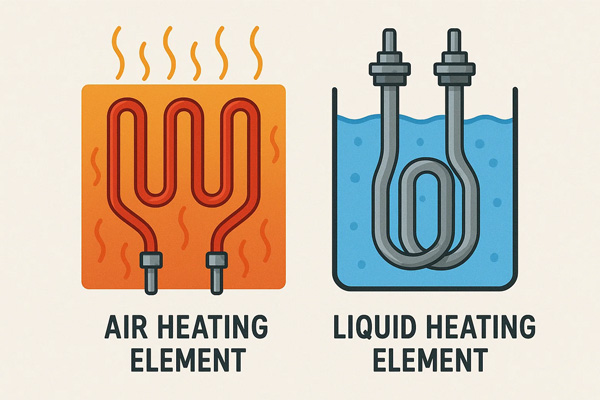
● Heating Air (Dry Heating)
Ovens / industrial dryers: W-shaped heating tubes inside
Fan heaters: Often wrapped with spiral metal fins (called finned tubular heaters) to improve heat dissipation
● Heating Liquids (Water / Oil)
Electric kettles / water heaters: Immersed in water
Deep fryers: Immersed in cooking oil
Note: Water heating elements usually have higher power.
Oil heating elements must use lower power density to avoid overheating.
● Contact Heating (Less common)
Some plate-heating machines clamp tubular elements inside metal plates for heat transfer.
3. Cartridge Heater vs. Tubular Heater: What’s the Difference?
People often confuse these two, so here’s the simple breakdown:

● Output Wires
Cartridge heater: Single-end wiring (both wires come out of the same end)
Tubular heater: Double-end wiring (a terminal on each side)
● Installation Method
Cartridge heater: Inserted into a hole
Tubular heater: Exposed in air, submerged in liquid, or fixed onto a tank wall with threaded fittings
4. The Most Important Rule: Don’t Use the Wrong Type!
For tubular heaters, there is one golden rule:
Choose the heater based on what you’re heating. Never mix them up.
❌ NEVER dry-fire a liquid heating tube!
Heaters designed for water/oil have very high power density because the liquid cools them quickly.
If you energize a water heater in open air:
It will turn red,
Overheat,
Crack or even melt within seconds to minutes.
Remember:
A fish dies without water — a water heating tube explodes without water.
✔ Choose the correct sheath material
| Application | Recommended Material |
|---|---|
| Normal water | Stainless steel 304 |
| Drinking water / high temperature | Stainless steel 316 |
| Air heating | Iron tube (low cost) or stainless steel |
| Corrosive liquids (plating industry) | Teflon (PTFE) or titanium |
Choosing the wrong material leads to corrosion, leakage, or tripping.
5. How to Choose the Right Tubular Heating Element?
Besides voltage and power, pay attention to these key factors:
● Shape & Dimensions
U-shape, W-shape, straight rod — and especially the center distance between terminals.
This determines whether it fits your equipment.
● Threaded Fittings
For installation in water tanks, the heater usually comes with a threaded bushing.
You must know the thread size (e.g., 3/4″, 1″) or it won’t fit.
● Working Environment
Tell your supplier whether you are heating air, water, or oil.
This determines power density, materials, and internal design.
Summary
A tubular heating element is the highly versatile, bendable, double-ended heater used for heating air, water, oil, and more.
Core advantages:
Flexible shapes
Cost-effective
Easy to install
Critical weakness:
Highly application-specific. A water heater must stay in water during operation.
Buying checklist:
Confirm shape & dimensions
Choose the correct stainless steel or corrosion-resistant material