 Skip to content
Flange water heaters – electric, reliable and customizable
Engineered for tanks, vessels, and process water systems. Achieve precise temperature control in the most demanding environments.
- Rapid Heating: High thermal efficiency for fast temperature rise.
- Built to Last: SS304/316 or Incoloy construction resists corrosion.
- Safety First: Explosion-proof (ATEX/ISO) options available.
What Is a Flange Water Heater?
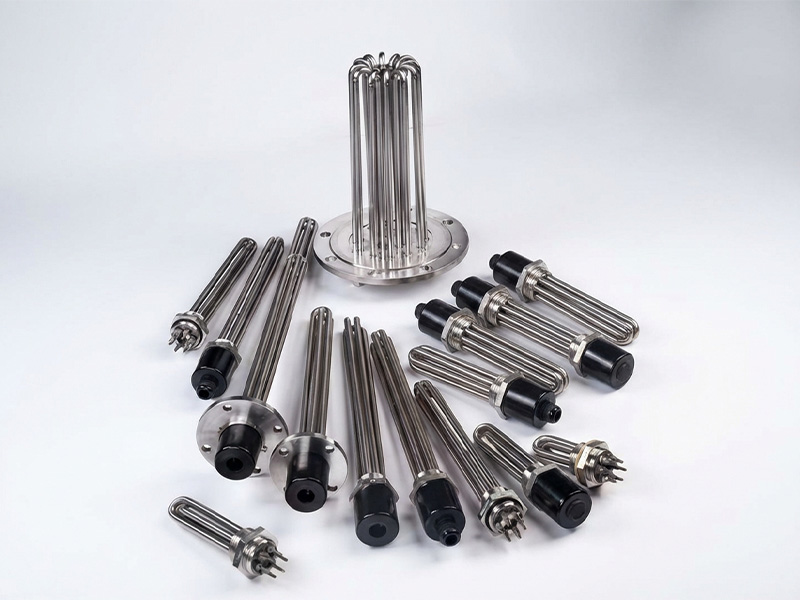
A flange water heater is an industrial electric immersion heater designed to heat water directly inside a tank, vessel, or process system.
It is mounted through a flanged connection on the tank wall, allowing the heating elements to be fully immersed in water for efficient and uniform heat transfer.
From the customer’s perspective, a flange water heater offers:
Direct and fast heating without external heat exchangers
High heating efficiency with minimal energy loss
Easy installation and maintenance via standard flange mounting
Reliable operation for continuous industrial processes
Flange water heaters are commonly used in water treatment plants, chemical processing, food & beverage production, pharmaceutical facilities, and power generation systems, where stable and controlled water heating is critical.
Why Choose Elekheat Flange Heaters?
Industrial buyers face challenges like downtime and corrosion. Our heaters solve these with robust design and precise control.
Fast & Efficient
Achieve rapid water temperature rise to meet process demands. Even heat distribution prevents hotspots and protects your tank.
Industrial Durability
Constructed with SS304/316 or Incoloy. Withstands high pressure (up to 25 bar) and minimizes maintenance needs.
Fully Customizable
Flanges to ANSI/DIN/JIS standards. Voltages from 220V to 480V. Wattage tailored to your specific immersion length.
How to Customize a Flange Water Heater
Every industrial process is different. That’s why flange water heaters should be custom-designed, not one-size-fits-all.

Flange Type & Size
- ANSI / DIN / JIS standards
- Custom flange diameter and thickness
- Pressure rating matched to your tank

Heating Element Material
- SS304 – standard water applications
- SS316 – corrosive or treated water
- Incoloy – high temperature or aggressive environments

Power & Electrical Configuration
- Voltage: 220V / 380V / 415V / 480V
- Power output tailored to heating speed requirements
- Single-phase or three-phase options

Immersion Length
- Designed to match tank depth and avoid dry heating
- Optimized for even heat distribution

Optional Accessories
- Built-in thermostat
- Temperature sensors (PT100, thermocouple)
- Explosion-proof terminal box
- Control panel integration
Technical Specifications
| Feature | Specification |
| Material Options | SS304, SS316L, Incoloy 800/840 |
| Power Range | 1 kW – 100 kW+ (Customizable) |
| Voltage | 220V / 380V / 415V / 480V (3-Phase available) |
| Flange Standards | ANSI, DIN, JIS (e.g., 3″ to 14″ Flanges) |
| Protection Class | IP66 (Moisture) / Explosion-Proof (ATEX/Ex d) |
| Max Op. Temp | Up to 400°C (Model dependent) |
| Pressure Rating | Up to 25 bar |
💡 Engineer's Tip: Material Selection
Not sure which material to choose? Here is a quick guide:
- SS304: Standard fresh water, non-corrosive heating.
- SS316: Process water, mild chemicals, deionized water.
- Incoloy: High temperature, corrosive solutions, or high-pressure tanks.
Need a Power Calculation?
Don’t guess your wattage. Provide us with your Tank Volume and Target Temperature, and our engineers will calculate the exact kW needed to heat your water in your desired timeframe.
Where Our Heaters Excel

Chemical & Petrochemical
Heat water for reaction vessels or cleaning processes. Resistant to corrosive environments.

Water Treatment & Boilers
Maintain temperatures for purification systems and prevent scaling in industrial boilers.

Food & Beverage
Sanitary materials (SS316L) ensure consistent water temp for cleaning and production.
Installation & Maintenance
Simple Installation Guide
Our heaters feature pre-drilled flange holes for fast assembly conformant to ANSI/DIN standards. Always ensure the immersion length fits the tank depth to avoid dry firing.
Maintenance Requirements
Designed for low maintenance. We recommend periodic inspection for scale buildup (calcium deposits). Elements are replaceable if needed.
Troubleshooting Tips
Heater not reaching temp? Check 3-phase voltage balance and wiring. Uneven heating? Inspect element placement and circulation.

Water Flange Heater vs Oil Flange Heater – What’s the Difference?
Although they look similar, water flange heaters and oil flange heaters are engineered very differently. Choosing the wrong type can lead to premature failure.
| Aspect | Water Flange Heater | Oil Flange Heater |
|---|---|---|
| Heat Transfer | Fast, efficient | Slower, higher thermal resistance |
| Surface Load | Higher allowed | Must be lower |
| Element Design | Compact | Larger heating surface |
| Temperature Control | Simpler | More precise required |
| Risk | Scaling | Carbonization |
Frequently Asked Questions
A: They are used to heat large volumes of water in industrial tanks, vessels, or process systems, typically in chemical, food, or general manufacturing industries.
A: Flange heaters are larger, more durable, and designed for high-power/high-volume tanks. Screw plug heaters are generally for smaller, lower-power applications.
A: Yes. We customize voltage (up to 480V+), wattage, and immersion length to fit your specific tank dimensions.
A: Absolutely. We offer ATEX, IECEx, and ISO certified explosion-proof enclosures for hazardous zones.