Skip to content
Choosing the wrong sheath material for your flange immersion heater leads to rapid corrosion, expensive downtime, and safety risks. Replacing a heater every month is a waste of capital. Finding the right balance between cost and durability is the key to a profitable operation.
To select the right material for a flange immersion heater, you must match the sheath to the specific chemical properties of the medium. Use 304 or 316L stainless steel for water, Titanium for strong acids, and Incoloy 800/825 for high-temperature oils or gases. Choosing based on chemical compatibility ensures a longer lifespan and prevents tank contamination.
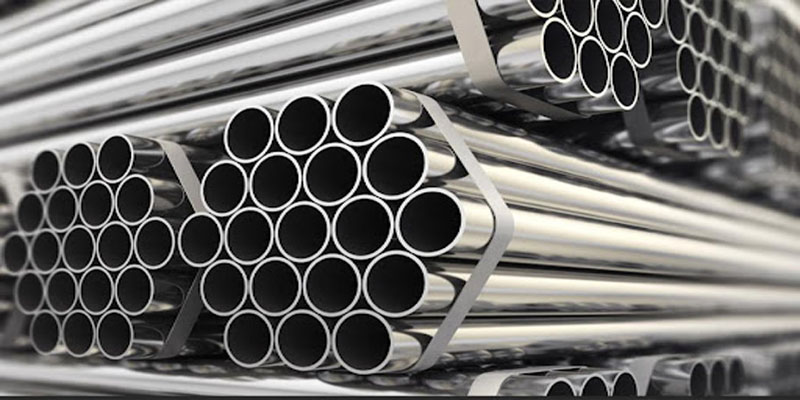
In my 25 years at ELEKHEAT, I have seen thousands of failed heaters. Most failed because the buyer chose the cheapest material instead of the right one. This guide will help you avoid those mistakes.
Which liquid-based sheath material is best for your application?
Using the wrong material in liquid is like putting a standard kettle element into a vat of acid. It will dissolve. You need a material that can survive constant contact with liquids, salts, or chemicals without corroding.
The best material depends on the presence of ions (like chlorine) and the acidity of the liquid. For general water heating, 304 or 316L stainless steel works best. For highly corrosive sea water or strong acids, Titanium or PTFE (Teflon) is required to prevent rapid pitting.
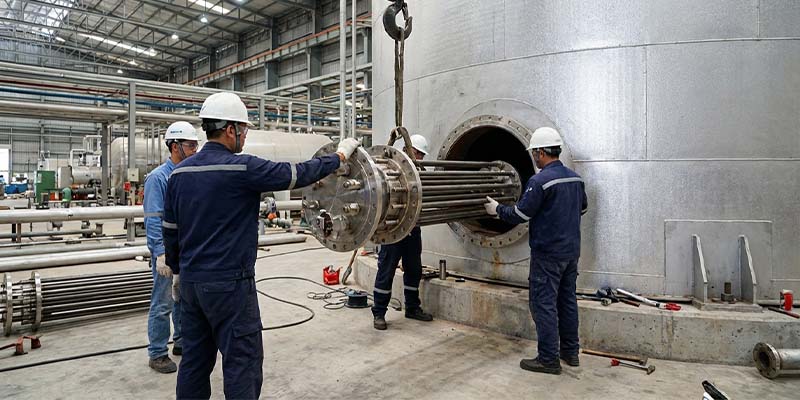
Deep Dive into Liquid Sheath Options
At our 48,000 sqm production facility, we categorize liquid heaters into five main "types" based on their chemical resistance.
1. Stainless Steel 304 & 316L
SS304 is the industry standard for clean water and food processing. However, it struggles with chlorine (found in tap water or bleach). For environments with salt spray or mild chemicals, we always recommend 316L. It contains 2% Molybdenum, which acts like a "vaccine" against corrosion. We often use 316L for swimming pools and electroplating tanks.
2. Titanium: The Corrosion Killer
Titanium is light and expensive, but it has a unique "self-healing" oxide layer. If the surface is scratched, it regenerates instantly. This makes it the only choice for desalination plants and concentrated acids. In our experience, while the initial cost is 8 times higher than 316L, it often lasts 10 times longer in harsh environments.
3. PTFE (Teflon) Coating
When dealing with "devil chemicals" like hydrofluoric acid, even metal fails. We use PTFE coatings for these scenarios. It is chemically inert. However, keep in mind that PTFE has poor thermal conductivity; you will need more surface area to achieve the same heating capacity.
Liquid Material Comparison Table
| Material | Best Use Case | Pros | Cons |
|---|---|---|---|
| SS304 | Hot water, food | Low cost, hygienic | Pits in salt/chlorine |
| SS316L | Salt water, mild acids | High salt resistance | Sensitive to high-temp sulfuric acid |
| Titanium | Strong acids, sea water | Self-healing, nearly immortal | Very high cost |
| PTFE | Ultra-pure acids, semiconductors | Zero chemical reaction | Poor heat transfer, fragile |
How do oil and gas environments change your heating element needs?
Heating oil or gas is different from heating water. These environments often involve high temperatures and the risk of "carbonization" (burning the oil onto the heater). If the material cannot handle the heat, the sheath will crack or melt.
For oil and gas, you must prioritize temperature resistance and structural strength. Carbon steel is efficient for moisture-free oil, while Incoloy 800 or 825 is the premier choice for high-temperature gases and sulfur-rich heavy oils. Always check for moisture; carbon steel will rust instantly if water is present.
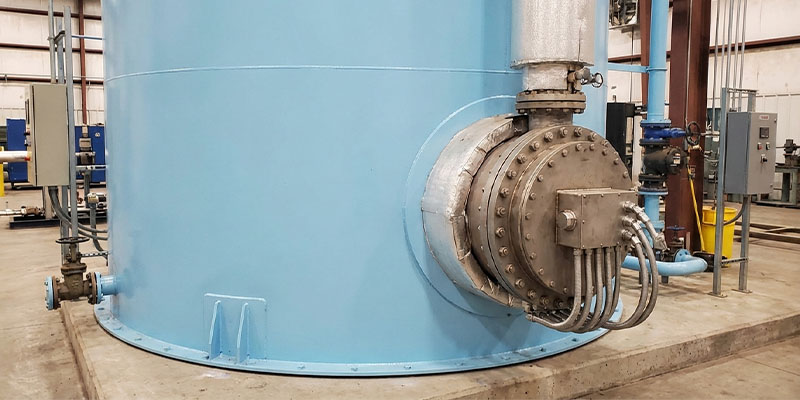
Deep Dive into Oil and Gas Materials
Heating fluids like bitumen, crude oil, or nitrogen requires specific metallurgical properties.
1. Carbon Steel vs. Incoloy
Carbon steel is a "workhorse" for closed-loop thermal oil systems where no moisture exists. It is cheap and transfers heat beautifully. However, if your oil contains sulfur or vanadium, carbon steel will fail rapidly. In these "dirty" oil environments, we switch to Incoloy 800 or 825. These alloys contain high nickel and chromium levels, preventing the metal from becoming brittle at 1,000°C.
2. Handling High-Temperature Gases
When heating air or CO₂, "scaling" is the enemy. Regular steel will peel like an onion at high temperatures. We recommend 310S (also known as 2520) for temperatures up to 1,000°C. If you need even higher temperatures for laboratory furnaces, we use Ceramic sheaths. Ceramics can withstand 1,500°C, though they are brittle and must be handled with care.
3. The Welding Factor
For heavy industrial heaters with many weld points, we use SS321. It contains Titanium, which prevents "weld decay." This ensures the heater doesn't crack at the joints when heating thick fluids like asphalt.
Oil & Gas Material Selection Table
| Medium | Recommended Material | Temp Range | Key Feature |
|---|---|---|---|
| Clean Thermal Oil | Carbon Steel | Up to 300°C | Most economical |
| Crude Oil (Sulfur) | Incoloy 825 | Up to 600°C | Resists carbonization |
| High Temp Air/Gas | SS310S (2520) | Up to 1,000°C | No scaling or peeling |
| Ultra-High Temp Gas | Ceramic | Up to 1,500°C | Excellent insulation |
Why are specialized materials critical for explosion-proof environments?
In oil rigs, refineries, and chemical plants, a single spark can be catastrophic. Explosion-proof (Ex-proof) heaters require more than just a strong sheath; they require a total system approach involving thick flanges and specialized terminal boxes.
For hazardous areas, use Incoloy 825 or 316L for the heating element combined with a heavy-duty Ex d IIC certified enclosure. These materials prevent internal sparks from reaching the external explosive atmosphere while resisting the corrosive gases typical of refineries.
Deep Dive into Hazardous Area Protection
When we build heaters for oil fields or hydrogen plants, we focus on the "Zone" and the "Gas Group."
1. The "Big Brother" Construction
For Zone 1 and 2 environments, the material of the flange is just as important as the heater sheath. We often use forged 316L or Incoloy 825 for the entire flange assembly. This eliminates seams and prevents "stress corrosion cracking" caused by high-pressure hydrogen or hydrogen sulfide (H₂S).
2. Protective Coatings in Offshore Settings
On offshore platforms, the salt mist eats through metal in months. We often apply C5-M rated anti-corrosion coatings to the terminal boxes. For the heating elements themselves, we might use a dual-approach: a 316L core with a fluoropolymer spray. If the coating is chipped, the 316L still provides a second line of defense.
3. Sealing and Maintenance
In our experience, it isn't the metal that usually fails—it is the seals. We use high-grade silicone or cast aluminum glands certified for Ex d IIC. We tell our clients: the material keeps the heater alive, but the seals keep your factory from exploding.
Explosion-Proof Features Table
| Component | Material | Certification | Purpose |
|---|---|---|---|
| Heating Core | Incoloy 825 | NACE MR0175 | High-pressure H₂S resistance |
| Terminal Box | Forged 316L / Aluminum | ATEX / IECEx | Spark containment |
| Flange | Integrated Forged Alloy | Ex d | No weld-seam leaks |
| Seals | Flame-retardant Polymer | IP66/IP67 | Waterproof & Gas-tight |
Conclusion
Choosing a material is always a balance of cost, temperature, and chemical compatibility. There is no "perfect" material—only the right compromise for your specific budget and environment.
At ELEKHEAT, we don't just sell heaters; we provide engineering solutions based on 25 years of manufacturing excellence. Whether you need a simple 304 water heater or a complex Titanium explosion-proof system, we can customize a solution for your facility.
Contact us today to discuss your technical specifications and get a custom quote.