 Skip to content
Liquid Heating Solutions
Precision Electric Heaters for Water, Oil, Chemicals & Process Fluids
What Is Liquid Heating?
Industrial liquid heating is the engineered transfer of thermal energy into fluids to achieve precise temperature parameters. This process operates via direct immersion or indirect contact to facilitate process control, viscosity reduction, freeze protection, or sterilization.
Core Heating Methods
Direct Immersion Heating: The heating element (typically a flanged or threaded tubular heater) is entirely submerged in the fluid. This yields nearly 100% heat transfer efficiency. It is the standard for water, mild chemicals, and rapidly flowing liquids.
Indirect Heating: The element is housed within a pipe insert or clamped to a vessel exterior, transferring heat without physically contacting the fluid. This prevents element contamination and allows for maintenance without draining the tank. It is strictly required for highly corrosive fluids, thick slurries, or extreme-purity applications (e.g., semiconductor manufacturing).
Typical Liquids
- Water: Process, potable, and Deionized (DI).
- Oils: Thermal fluids, fuel oil, hydraulic oil, lubrication oil.
- Chemicals: Acids, alkalines, solvents.
- Specialty Fluids: Food-grade liquids, glycol mixtures.
Key Engineering Variables
Engineer’s Tip: Before specifying a heater, verify these parameters:
Target temperature (°C) | Static volume vs. flow rate | Tank dimensions and geometry | Maximum operating pressure | Fluid corrosiveness (pH level) | Dynamic viscosity (cP) | Hazardous area classification (e.g., ATEX/IECEx).
Heating Solutions for Liquid Applications

Screw Plug Immersion Heaters
Description: Compact immersion heaters utilizing high-purity MgO powder, threaded directly into tanks.
Advantages: Simple installation, cost-effective, ideal for confined spaces.
Limitations: Restricted to smaller outputs; strictly requires matching thread standards.
Flanged Immersion Heaters
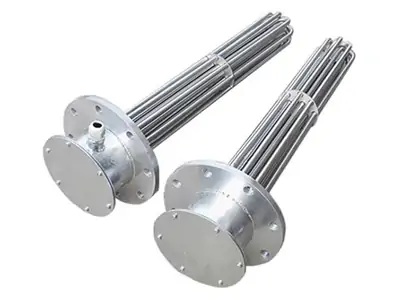
Description: High-capacity immersion heaters welded to an ANSI or DIN flange, for heavy-duty industrial tanks.
Advantages: Extreme power capacity (up to megawatts), custom watt densities, robust construction.
Limitations: Higher capital cost, requires dedicated tank flange modifications.

Over-the-Side Immersion Heaters
Description: Portable heaters engineered to hang over the lip of a tank.
Advantages: Zero tank modification required, rapid deployment, exceptional for temporary processes.
Limitations: Lower structural rigidity, zero pressure capability (open tanks only).
Circulation (In-Line) Heaters
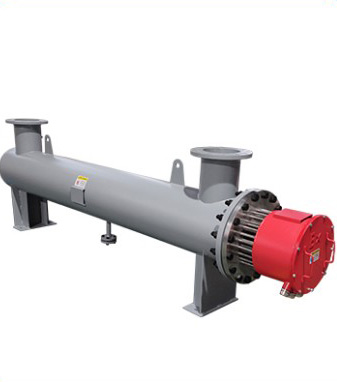
Description: Flanged or screw plug heaters installed inside a pressurized vessel to instantly heat flowing liquids.
Advantages: High-precision outlet temperature control, built for high-pressure closed-loop systems.
Limitations: Mandates a pump system, complex fluid dynamics engineering.
Flexible Heaters
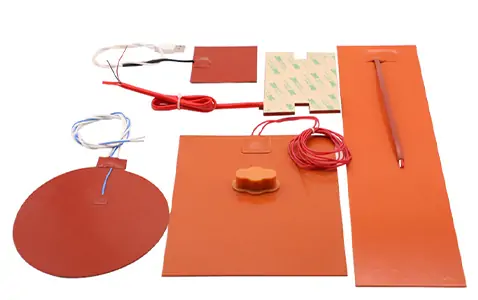
Description: Silicone rubber or polyimide surface heaters applied to the exterior for indirect transfer.
Advantages: Ultra-lightweight, uniform distribution, excellent for freeze protection.
Limitations: Indirect heat transfer (slower), strict max temperature limits (<200°C).
Product Comparison Table
| Product Type | Installation | Power Range | Best for Flow | Pressure Capability | Cost Level |
|---|---|---|---|---|---|
| Screw Plug | Threaded | Low – Medium | No | Low – Medium | Low |
| Flanged | Bolted flange | Medium – Very High | No | Medium – High | Medium |
| Over-the-Side | Hanging | Low – Medium | No | Open tanks only | Medium |
| Circulation | Inline vessel | Medium – Very High | Yes | High | High |
| Flexible | Surface mount | Low – Medium | Indirect | N/A | Low |
Heater Selection by Liquid Type
Water Heating
Challenges: Mineral scale accumulation, oxygen-induced corrosion.
Recommended: Screw plug for small utility tanks; flanged for municipal storage; circulation for continuous flow.
Oil Heating
Challenges: High viscosity limits flow, severe risk of thermal degradation (carbonization/coking).
Recommended: Low watt density flanged immersion heaters; circulation heaters paired with flow control.
Corrosive Chemicals
Challenges: Aggressive chemical attack on standard metal sheaths.
Recommended: Titanium flanged heaters; PTFE-coated over-the-side heaters; specialized alloy screw plug.
Freeze Protection
Challenges: Requires consistent, low-level heat maintenance without fluid degradation.
Recommended: Flexible silicone surface heaters; low-power screw plug heaters.
Calculation Tools
Heater Power & Specification Calculator
• Recommended Watt Density: 8–15 W/cm²
• Recommended Material: SS 304 (Standard clean water), SS 316L (DI water, food processing), Incoloy 800/840 (High-temp water, hard water)
Always use Thermostats, RTD, Level Switches (dry-run protection), and Explosion-Proof enclosures where required.
*Formula: P = (m × cp × ΔT) / t. Result includes a 20% safety factor for system heat loss.
Industrial application scenarios
Industry Application Scenarios
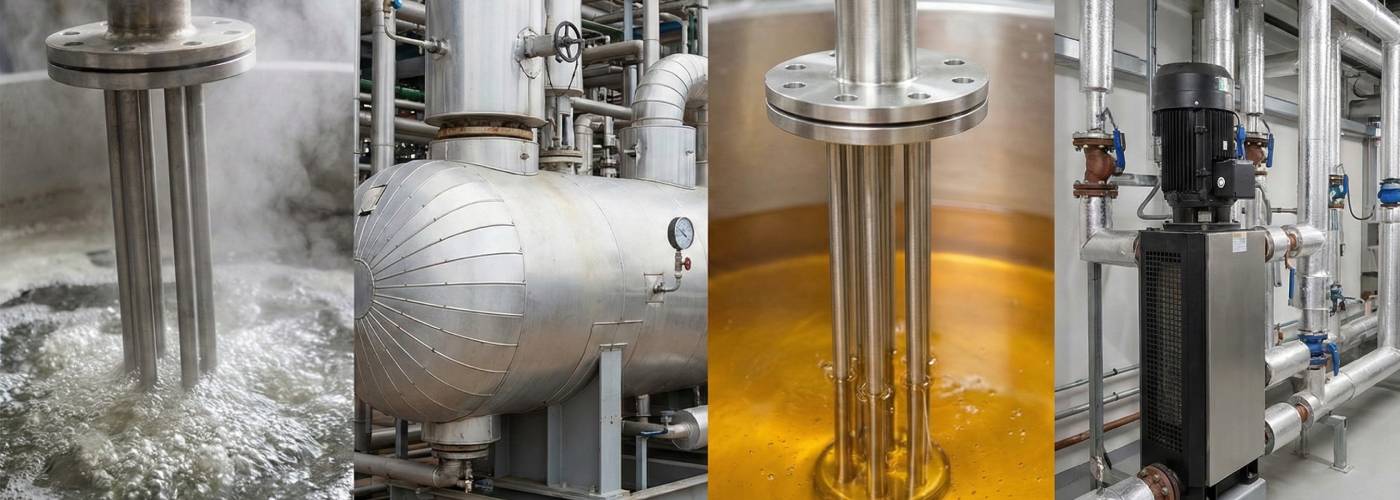
Chemical Industry: Flanged titanium immersion heaters installed in acid reaction tanks.
Oil & Gas: High-pressure in-line circulation heaters for crude oil viscosity reduction.
Food Processing: 316L sanitary flanged heaters maintaining syrup fluidity.
HVAC: Circulation heaters integrated into closed-loop glycol systems.
Energy Efficiency & Cost Control
Insulation Thickness Optimization: Drop ambient heat loss below 5%.
Multi-Stage Control: Sequence heating banks to fire incrementally.
SCR Power Control: Proportional power delivery matches exact thermal demand.
Heat Loss Estimation: Account for uninsulated tank walls and open lids.
Frequently Asked Questions
For clean water in small tanks, a screw plug heater with a 304SS sheath is sufficient. For large industrial tanks, a flanged immersion heater utilizing a 316L or Incoloy sheath offers the best longevity and power capacity.
Install an independent liquid level switch (float or optical) wired to a contactor that cuts power to the heater if the liquid drops below the heating elements.
Watt density strictly depends on fluid viscosity and thermal stability. Use 8–15 W/cm² for water, 2–4 W/cm² for light oils, and under 2 W/cm² for heavy oils to prevent fluid carbonization.
No. Flexible heaters (silicone/polyimide) are designed strictly for indirect surface heating. They clamp onto the exterior of pipes or tanks and conduct heat through the vessel wall into the fluid.
Specify an in-line (circulation) heater when dealing with flowing fluids in a closed-loop system, when space inside a storage tank is restricted, or when precise outlet temperature control is mandatory.
