 Skip to content
Choosing the wrong flange heater leads to sudden equipment failure and expensive downtime. Stop guessing and start specifying with precision. Use this guide to optimize your heating efficiency and ROI.
To select a flange immersion heater, you must match the watt density to your fluid, choose a corrosion-resistant sheath material (such as 316L or Titanium), ensure the heating elements remain fully submerged, and verify safety certifications like CE or ISO to prevent industrial accidents.
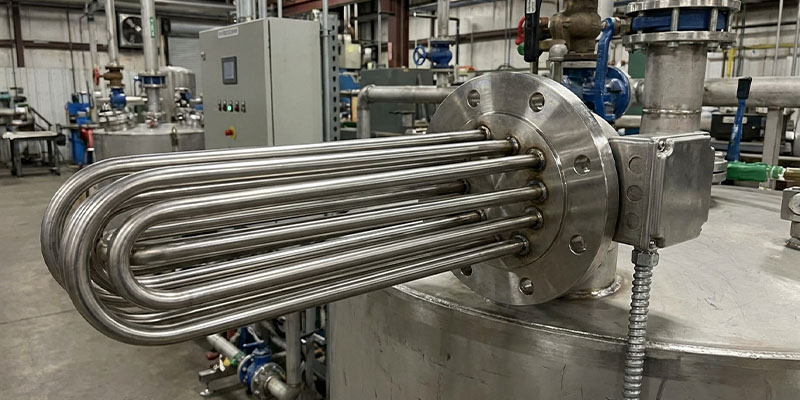
Choosing high-quality industrial components requires a systematic approach. At ELEKHEAT, we have refined this process into five essential steps.
1. How do you calculate the required power and watt density?
Miscalculating power leads to slow heating or premature heater burnout. High watt density on a short tube might seem cheaper, but it kills the heater’s lifespan almost immediately.
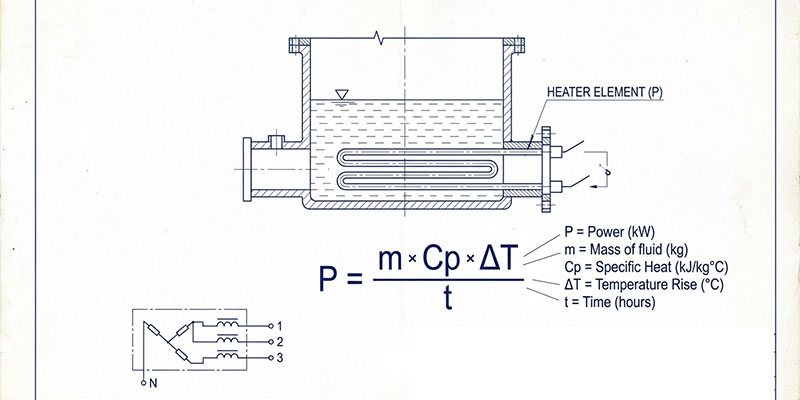
Calculate your required power (kW) by multiplying the volume (Liters) by the temperature rise (°C) and 4.2, then dividing by the heating time (seconds) and 1000. Keep the surface load below 3 W/cm² for water to double your heater's lifespan.
Deep Dive into Power Dynamics
In our 25 years of manufacturing at ELEKHEAT, we see many buyers prioritize "compactness" over durability. If you need 30 kW of power, one supplier might offer a 0.3-meter heater, while we recommend a 1-meter heater. The shorter heater has a much higher surface temperature. This "watt density" is the most critical factor in industrial heating.
When the watt density is too high, the fluid cannot whisk away the heat fast enough. This causes the internal resistance wire to overheat and snap. I always tell my clients: "Spread the heat out." By using longer elements or more "U-shaped" bends, we keep the surface load low. For water, we aim for ≤ 3 W/cm². For heavy oil, we drop as low as 1-2 W/cm². This ensures the heater lasts years, not months.
Power and Watt Density Guidelines
| Fluid Type | Recommended Watt Density | Common Power Range |
|---|---|---|
| Clean Water | 6 - 8 W/cm² | 3kW - 500kW |
| Circulating Oil | 2 - 3 W/cm² | 2kW - 100kW |
| Heavy Fuel Oil | 1 - 1.5 W/cm² | 5kW - 60kW |
| Corrosive Chemicals | 1.5 - 2 W/cm² | Custom based on tank |
2. Which sheath material is best for your specific environment?
The sheath is the "armor" of your heating element. If you choose the wrong metal, the liquid will eat through the tube in a matter of days. This is where most procurement mistakes happen.
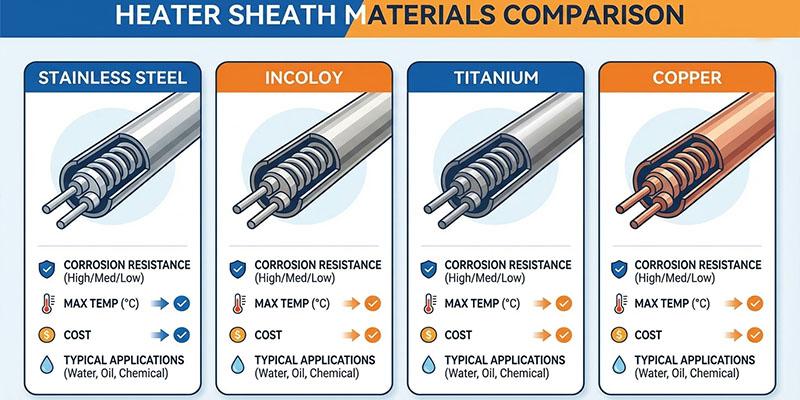
Select 304 stainless steel for clean water, 316L for saltwater or groundwater, and Carbon Steel for oils. For aggressive chemicals or high-temperature alkaline solutions, use Incoloy 800 or Titanium to prevent pitting and stress corrosion.
Deep Dive into Materials Science
At our 48,000 sqm plant, we maintain a strict inventory of certified steel grades. We often see "budget" suppliers use Grade 201 stainless steel but label it as "Stainless Steel." Within weeks, Grade 201 will rust and crack. We treat material selection as a chemical compatibility problem.
Why Material Grades Matter
304 and 316L Stainless Steel
For standard industrial water heating, 304 is the baseline. However, if your water has high chloride levels (common in groundwater), you must jump to 316L. The added molybdenum in 316L provides much better resistance to "pitting"—those tiny holes that cause a heater to short circuit.
Specialty Alloys
If you are heating food-grade liquids or weak alkaline solutions, we utilize 321 stainless steel, which contains titanium to prevent intergranular corrosion. For the most demanding environments, like electroplating baths, we manufacture heaters with Titanium or Incoloy 800. We don't just sell a heater; we match the metallurgy to your chemistry.
Material Compatibility Reference
| Environment | Recommended Material | Benefit |
|---|---|---|
| Tap Water / Weak Acid | SS304 | Cost-effective, standard |
| Groundwater / High Chloride | SS316L | Resists pitting |
| Hydraulic / Lubricating Oil | Carbon Steel | Cheap, won't rust in oil |
| Food / Alkaline Solutions | SS321 | Resists high-temp corrosion |
| Strong Acids / Plating | Titanium / Incoloy | Superior chemical resistance |
3. How do length and installation affect performance?
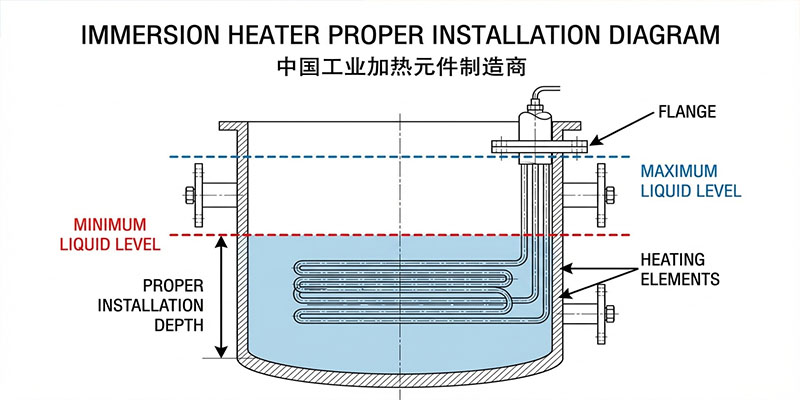
An immersion heater must stay "immersed." It sounds simple, but exposing even an inch of the heating element to air while it is powered on will cause it to melt instantly.
Measure your tank depth and ensure the "effective heating length" is at least 5cm below your minimum liquid level. Use standard flange sizes like DN50 or DN80 to ensure a high-pressure seal and architectural strength.
Deep Dive into Physical Installation
I have seen many "bargain" heaters fail because they were sold as standard off-the-shelf stock. If your tank is 0.8 meters deep, but you buy a 0.5-meter heater to save money, you leave a massive gap of unheated liquid at the bottom. Worse, if your liquid level fluctuates and the heater becomes exposed, it will dry-fire and explode.
Custom Bending and Fitting
At ELEKHEAT, we customize the "cold zone" of the heater. This is the part of the tube that does not generate heat. We ensure the cold zone extends past the flange and into the liquid. We also look at the flange interface. For high-pressure systems, we use heavy-duty forged flanges. A DN65 flange is common, but for industrial boilers, we move to larger flanges to handle the mechanical stress of the heat cycles.
Flange Specification Guide
| Flange Size (DN) | Bolt Holes | Pressure Rating | Common Use |
|---|---|---|---|
| DN50 | 4 | PN10 / PN16 | Small water tanks |
| DN65 | 4 | PN16 | Standard oil heaters |
| DN80 | 8 | PN16 / PN25 | Industrial boilers |
| DN100+ | 8+ | PN40 | High-pressure steam |
4. Why is integrated temperature control vital for safety?
A heater is just a tool; the controller is the brain. Without a "brain," your heater is a fire hazard. Relying solely on manual monitoring is a recipe for disaster in a b2b environment.
Always pair your flange heater with at least a mechanical thermostat (0-120°C) for over-temperature protection. For high-precision industrial use, integrate a PT100 sensor and an SSR digital control box to maintain ±1°C accuracy.
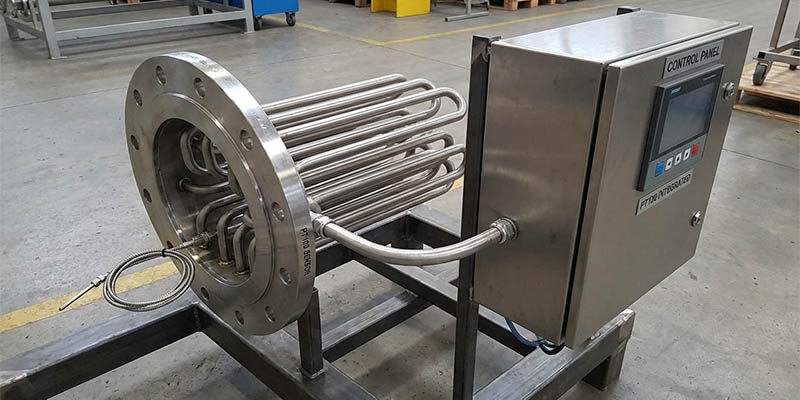
Deep Dive into Safety Systems
We believe safety is not an "add-on"—it is a requirement. In our factory, we design three tiers of control depending on the client’s budget and risk level.
H3: The Three Tiers of Safety
Level 1: Basic Protection
The lowest level is a mechanical dial thermostat. It is inexpensive and acts as a "kill switch" if the liquid gets too hot. It prevents the liquid from boiling over.
Level 2: Precision Control
The standard for most of our industrial clients is a PT100 RTD sensor paired with a Digital PID controller. This system is precise. It doesn't just turn "on and off"; it modulates the power to maintain a perfect temperature. This prevents "thermal shock" to the heating elements, extending their life by up to 30%.
Level 3: The "Fail-Safe" System
For critical processes, we add a liquid level switch and an SCR (Silicon Controlled Rectifier). If the liquid level drops, the SCR cuts power in milliseconds. This is the only way to 100% guarantee against dry-firing.
Control System Comparison
| Component | Accuracy | Cost | Best For |
|---|---|---|---|
| Mechanical Dial | ±5°C | Low | Small-scale water |
| Digital PID + PT100 | ±1°C | Mid | Most industrial tasks |
| SCR + Level Switch | ±0.1°C | High | Precision chemical/oil |
5. What certifications should you demand from a supplier?
In the industrial world, a "handshake" doesn't cover the cost of a factory fire. You need a paper trail. Certifications are proof that the manufacturer follows international safety and quality standards.
Demand a manufacturer’s "Pressure Vessel License," CE/ISO9001 certification, and a grounding resistance report (≤ 0.1 Ω). Ensure your contract specifically includes a 1-year warranty that covers tube failure due to manufacturing defects.
Deep Dive into Accountability
When you buy from ELEKHEAT, you aren't just buying metal; you are buying 25 years of engineering compliance. I always warn procurement managers to look at the weld quality on the flange. Poor welding under high pressure can lead to leaks and electrical shorts.
Why Paperwork Saves Money
If a heater fails, a "cheap" supplier will blame your water quality or "misuse." A professional supplier provides an RT (Radiographic Testing) report for the welds and a dielectric strength test report. This proves the heater left the factory in perfect condition. We include these in our documentation because we stand by our 48,000 sqm production facility's output. Make sure your contract includes "Free replacement and shipping for tube failure within 1 year." If the supplier won't sign that, they don't trust their own product.
Procurement Document Checklist
| Document Name | Why You Need It |
|---|---|
| ISO 9001 Certificate | Ensures consistent quality management |
| CE / UL Marking | Verifies electrical safety compliance |
| Material Mill Report | Proves the steel is actually 316L or 304 |
| RT Weld Report | Ensures the flange won't leak under pressure |
| Grounding Test | Protects workers from electric shock |
Summary: The (Insider) Checklist
Choosing a flange immersion heater comes down to five points: Power math, Material logic, Proper length, Smart controls, and Signed certificates.
If you follow these steps, you will reduce your maintenance costs by 40% and ensure your production line never stops. At ELEKHEAT, we specialize in custom-engineered heating elements for the world's most demanding industries. Contact us today to get a technical drawing and a quote for your specific needs.