 Skip to content
Reliable Industrial Thermocouples for Accurate Temperature Measurement
High-quality thermocouples for industrial heating, manufacturing, and process control. Custom designs available to meet your exact requirements.
Trusted by Engineering and Supply Chain Professionals Nationwide


What I Offer
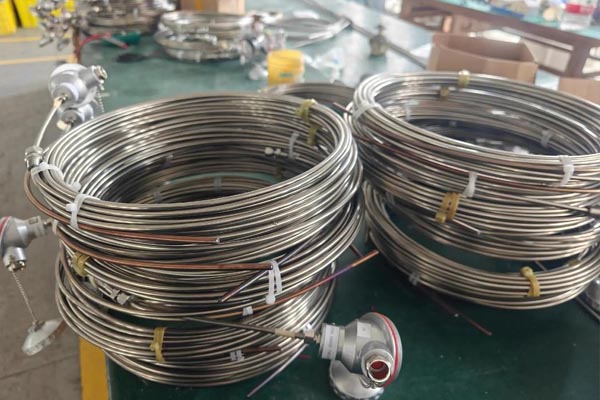
Custom and standard industrial thermocouples (Type K, J, T, E, N, S, R, B) with multiple sheath, length, and mounting options.
How Good is my Product?
Precision-built thermocouples made from quality alloys and 100% tested for reliable temperature measurement.
Why buy from me?
Stable quality, flexible customization, and reliable lead times for industrial applications.
Why Choose Our Thermocouples?
We understand industrial temperature measurement challenges. Our thermocouples convert temperature signals directly into thermoelectric potential with high precision. From custom dimensions to harsh environment protection, we ensure a seamless experience.
High-Precision Data
Solve: Inaccurate temperature readings
Available in Class I and Class II accuracy, ensuring stable and reliable thermoelectric potential output
Extreme Durability
Solve: Limited harsh environment performance
Sheaths available in 304/316 SS, Inconel 600, Molybdenum, and Tantalum to withstand vacuums, oxidation, and up to 2300°C
Versatile Installation
Solve: Complex integration issues
Multiple mounting options including screw-type, probe-type, snap-on, surface mount, and bulkhead configurations
Superior Cabling
Solve: Signal loss & wire degradation
Compensation wires use imported fluoroplastics for excellent waterproof, acid/alkali, and oil resistance (-60°C to 205°C)
Comprehensive Product Collection

Type K Thermocouple
One of the most widely used thermocouples for industrial applications.
- Temperature range: up to 1260°C
- Excellent oxidation resistance
- Suitable for furnaces and heating system

Type J Thermocouple
Reliable thermocouple for medium temperature measurement.
- Temperature range: up to 760°C
- Good sensitivity
- Used in ovens, boilers and HVAC equipment

Type T Thermocouple
High accuracy thermocouple suitable for low temperature environments.
- Temperature range: −200°C to 350°C
- Excellent stability
- Used in laboratories and refrigeration systems

Type E Thermocouple
Thermocouple with high output signal and good accuracy.
- Temperature range: up to 900°C
- High sensitivity
- Suitable for industrial temperature measurement

Type N Thermocouple
Improved thermocouple for high temperature and long-term stability.
- Temperature range: up to 1300°C
- Excellent oxidation resistance
- Used in high temperature industrial processes

Type S Thermocouple
Platinum thermocouple designed for high temperature applications.
- Temperature range: up to 1600°C
- High accuracy and stability
- Used in glass, ceramics and metallurgy
Type R Thermocouple
High precision platinum thermocouple for extreme environments.
- Temperature range: up to 1600°C
- Excellent long-term stability
- Used in high temperature furnaces
Type B Thermocouple
Thermocouple designed for extremely high temperature measurement.
- Temperature range: up to 1800°C
- Excellent durability
- Used in steel and glass industries

Type N Thermocouple
Improved thermocouple for high temperature and long-term stability.
- Temperature range: up to 1300°C
- Excellent oxidation resistance
- Used in high temperature industrial processes

Molten Aluminum Thermocouple
Platinum thermocouple designed for high temperature applications.
- Temperature range: up to 1600°C
- High accuracy and stability
- Used in glass, ceramics and metallurgy

Ni-Mo Thermocouple
High precision platinum thermocouple for extreme environments.
- Temperature range: up to 1600°C
- Excellent long-term stability
- Used in high temperature furnaces

Pt-Pd Thermocouple
Thermocouple designed for extremely high temperature measurement.
- Temperature range: up to 1800°C
- Excellent durability
- Used in steel and glass industries
Product parameters
| Index number | Thermoelectric electrode materia | Tolerance | Wire diameter (mm) | Common temperature (°C) | Maximum temperature (°C) | Permissible deviation (°C) | |
| + | – | ||||||
| T | Cu 100% | Ni 45% Cu 55% | Ⅰ,Ⅱ | 0.32 0.65 1.00 1.60 | 200 250 300 | 250 300 350 | ±0.5 |
| K | Ni 90% Cr 10% | Ni 97% Si 3% | Ⅰ,Ⅱ | 0.65 1.00 1.60 2.30 3.20 | 650 750 850 900 1000 | 850 950 1050 1100 1200 | ±1.5 |
| N | Ni 84.4% Cr 14.2% Si 1.4% | Ni 95.5% Si 4.4% Mg 0.1% | Ⅰ,Ⅱ | 0.65 1.00 1.60 2.30 3.20 | 850 950 1050 1100 1200 | 900 1000 1100 1150 1250 | ±1.5 |
| J | Fe100% | Cu 55% Ni 45% | Ⅰ,Ⅱ | 0.65 1.00 1.60 2.30 3.20 | 400 450 500 550 600 | 500 550 650 750 | ±1.5 |
| E | Ni90% Cr10% | Cu 55% Ni 45% | Ⅰ,Ⅱ | 0.65 1.00 1.60 2.30 3.20 | 450 500 550 600 700 | 500 550 650 750 800 | ±1.5 |
| R | Pt 87% Rh 13% | Pt 100% | Ⅰ,Ⅱ | 0.5 | 1400 | 1600 | ±1 |
| S | Pt 90% Rh 10% | Pt 100% | Ⅰ,Ⅱ | 0.5 | 1400 | 1600 | ±1 |
| B | Pt 70% Rh 30% | Pt 94% Rh 6% | Ⅰ,Ⅱ | 0.5 | 1500 | 1700 | |
.
Wide Range of Applications
Our thermocouples are trusted across critical industries:

Energy & Heavy Industry: Thermal Power Generation, Industrial Production, and Steel Mills

Advanced Manufacturing: Aerospace, Transportation Vehicles, and High-Temperature Furnaces

Processing & Machinery: Pharmaceutical Machinery, Food Processing, and Rubber & Plastics Machinery

Research & Health: Scientific Research Equipment, Meteorological Observation, and Medical Equipment

Energy & Heavy Industry: Thermal Power Generation, Industrial Production, and Steel Mills

Advanced Manufacturing: Aerospace, Transportation Vehicles, and High-Temperature Furnaces

Processing & Machinery: Pharmaceutical Machinery, Food Processing, and Rubber & Plastics Machinery

Research & Health: Scientific Research Equipment, Meteorological Observation, and Medical Equipment
Technical Advantages
Wide Temp Capabilities: Ranging from -200°C (Type T/K) up to 2300°C (Type C / Tantalum sheaths)
Structure Options: Exposed, Grounded, Insulated, and Separate Insulation to balance thermal response and anti-interference
Durable Cabling: Fluoroplastic insulation resists oil, water, acids, and aging through continuous extrusion processes
Custom Fitting: Quick-plug couplings, adjustable screws, and customizable probe diameters

How to Get a Custom Solution

Submit Specs
Place your order and receive your robust, high-precision thermal measurement tools.

Engineering Review
We confirm the sheath material (e.g., Inconel, Silicon Nitride) and accuracy class

Quotation
Receive your detailed quotation and samples if required for your specific application.

Delivery
Provide graduation type (K, J, R, etc.), length, temp range, and wire tail treatment (e.g., U-shaped fork, aviation connector)
Frequently Asked Questions
It depends on the graduation type and sheath. For example, Type T operates from -200°C to 350°C, Type S/R up to 1600°C, and Tungsten-Rhenium (Type C) can reach up to 2300°C
Yes. We offer PTFE-coated thermocouples for corrosive environments [cite: 390, 398], Silicon Nitride tubes for liquid aluminum [cite: 466, 469], and Tantalum/Molybdenum sheaths for high-temperature vacuums
Absolutely. Our compensation wires utilize imported high-quality fluoroplastics, making them waterproof, acid/alkali resistant, oil resistant, and non-combustible
The selection depends on several factors such as temperature range, environmental conditions, response time, and accuracy requirements. K-type is commonly used for high-temperature industrial applications, while J-type is suitable for medium-temperature environments.
Yes. We provide custom thermocouple solutions including probe length, sheath material, connector type, mounting thread, and insulation type to meet specific industrial requirements.
Contact Us
Tell us your needs, whether you are a purchaser or an individual buyer, we will arrange professional business people to connect with you.
Thermocouple Knowledge Guide
What Is a Thermocouple?
A thermocouple is a temperature sensor made from two different metal wires joined together at one end. When the junction experiences a temperature change, it generates a small voltage that can be measured and converted into temperature.
Because of their wide temperature range, fast response time, and durability, thermocouples are widely used in industrial temperature measurement and control systems.

How Does a Thermocouple Work?
Thermocouples operate based on the Seebeck Effect. When two different metals are joined together and exposed to a temperature difference, an electrical voltage is generated. This voltage corresponds to the temperature difference between the measuring junction and the reference junction.
Temperature measurement instruments interpret this voltage and convert it into an accurate temperature reading.
Common Types of Thermocouples
Different thermocouple types are designed for different temperature ranges and industrial applications.
| Type | Temperature Range | Key Features | Typical Applications |
|---|---|---|---|
| K-Type | -200°C to 1260°C | Most common, high temperature resistance | Furnaces, industrial heating |
| J-Type | -40°C to 750°C | Cost-effective, good for medium temperatures | Manufacturing equipment |
| T-Type | -200°C to 350°C | Excellent for low temperatures | Laboratories, refrigeration |
| N-Type | -200°C to 1300°C | High stability and oxidation resistance | Aerospace, power plants |
Thermocouple vs RTD Sensors
Both thermocouples and RTD sensors are used for temperature measurement, but they have different advantages.
| Feature | Thermocouple | RTD |
|---|---|---|
| Temperature Range | Very wide, up to 1800°C | Usually up to 600°C |
| Accuracy | Moderate | High |
| Response Time | Faster | Slower |
| Durability | Excellent in harsh environments | More sensitive |
Thermocouples are often preferred in high-temperature and industrial environments, while RTDs are used where high precision at lower temperatures is required.
