Skip to content
Premature heater failure is one of the most frustrating and costly issues in industrial manufacturing. More often than not, the root cause isn't a defective part, but a miscalculation in one critical metric: watt density. If you are an engineer or procurement specialist looking to optimize your thermal systems, understanding how to match the right power output to your specific medium is non-negotiable.
This Watt Density Guide will walk you through everything you need to know—from basic calculations to advanced material selection—ensuring your next heating project runs efficiently, safely, and longer.
What is Watt Density and How Does It Work?
In the world of industrial heating, watt density refers to the amount of electrical power (watts) concentrated on a specific surface area of a heating element. It is typically measured in Watts per square inch (W/in²) or Watts per square centimeter (W/cm²).
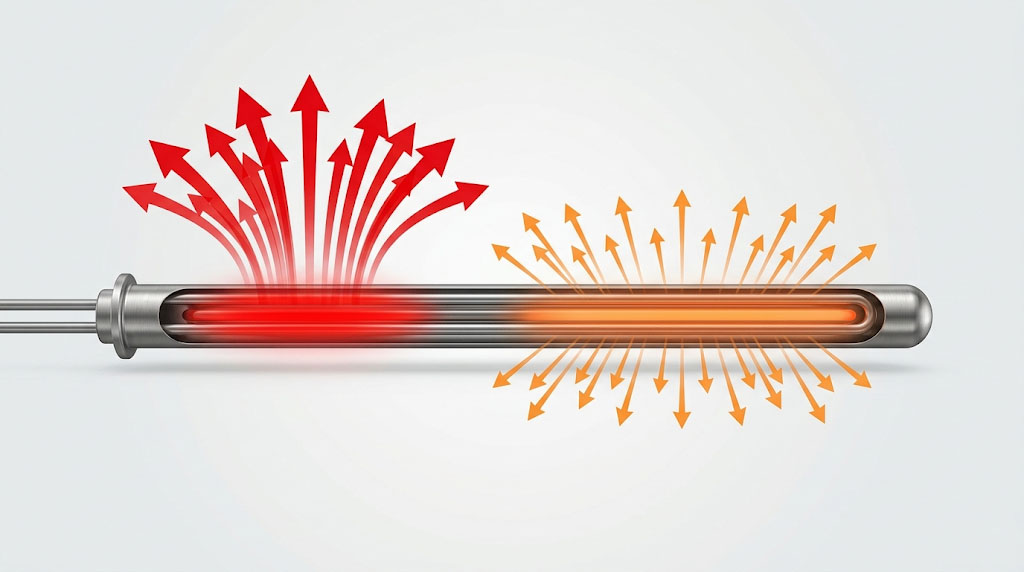
Think of it as the "heat intensity" of the element. A heater with a high watt density delivers a massive amount of heat from a small surface area, whereas a low watt density heater spreads the same amount of heat over a much larger surface.
To determine the watt density of a tubular or cartridge heater, engineers use the following formula:
Watt Density = frac{Total Heater Wattage (W)}{Heated Surface Area (in²)}
Note: The "heated surface area" only includes the active heating zone, excluding the cold pins at the terminals.
Choosing the correct watt density ensures that the heat transfers efficiently into the surrounding medium (gas, liquid, or solid) without causing the heater's internal resistance wire to overheat and burn out.
High vs. Low Watt Density: A Comparative Analysis
When specifying a heating element, choosing between high and low watt density depends entirely on what you are trying to heat. Below is a breakdown of how they compare:
| Feature/Dimension | High Watt Density | Low Watt Density |
|---|---|---|
| Heat-Up Speed | Fast. Provides rapid temperature increases. | Gradual. Slower, more controlled heating. |
| Physical Size | Compact. Delivers high power in a smaller footprint. | Bulky. Requires a longer/larger element to spread out the wattage. |
| Sheath Material | Requires high-grade alloys (e.g., Incoloy, Stainless Steel 316) to withstand internal temperatures. | Can often use standard materials (e.g., Copper, standard Steel) depending on the medium. |
| Risk of Coking/Scaling | High risk in viscous fluids. Can scorch oils or cause rapid mineral buildup in hard water. | Low risk. Ideal for sensitive or easily degradable fluids. |
| Ideal Applications | Clean water, flowing gases, high-grade injection molding, die casting. | Heavy fuel oils, asphalt, corrosive chemicals, storage tank heating. |
Core Application Scenarios: Watt Density in Action
Understanding the medium you are heating is the most critical step. At elekheat, we frequently design customized heating solutions for Storage Tank Heating and Fluid Immersion Heating, where getting the watt density right is critical to process success.
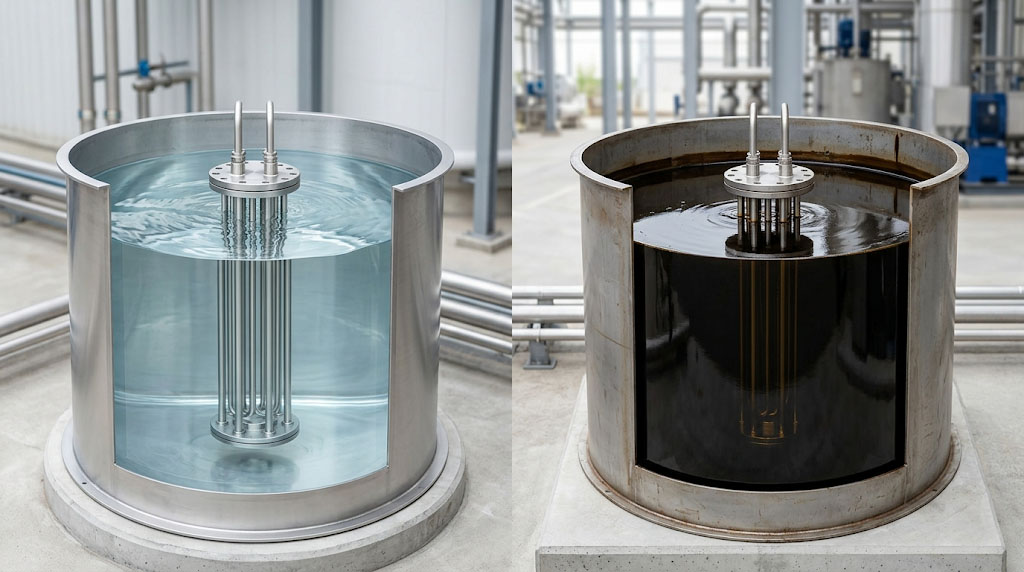
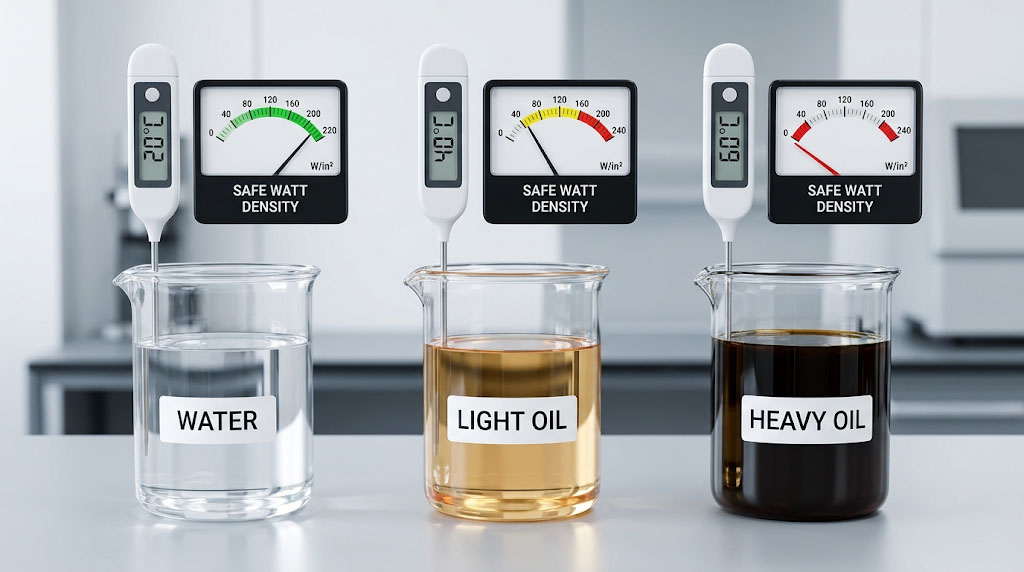
- Water Heating (High Watt Density): Water absorbs heat incredibly well. Standard clean water applications can handle watt densities ranging from 45 to 60 W/in². However, if the water contains high mineral content (hard water), a lower density is required to prevent rapid calcium scaling on the sheath.
- Oil & Hydrocarbon Heating (Low Watt Density): Oils have poor thermal conductivity and degrade (coke) if the heater surface is too hot. For light machine oils, 15 to 20 W/in² is standard. For heavy fuel oils, asphalt, or molasses, you must drop the watt density down to 5 to 10 W/in² to prevent the liquid from burning and insulating the heater.
- Gas and Air Heating: Air is a poor conductor of heat. Depending on the airflow (velocity) and the required outlet temperature, finned tubular heaters are often used to increase the surface area, allowing for safe operation at moderate watt densities.
Step-by-Step: Calculating Watt Density for Different Mediums
To accurately size your heating element, you need to understand the relationship between your total power requirement and the physical size of the heater. Here is the standard formula used by thermal engineers:
Watt Density = frac{Total Wattage (W)}{Heated Surface Area (in²)}
For a standard cylindrical tubular heater, the Heated Surface Area is calculated using the diameter and the active heated length (excluding the unheated cold sections at the ends):
Surface Area = pi times Diameter times Heated Length
Watt Density Limits by Medium
The allowable watt density is entirely dictated by the medium's ability to absorb heat and its susceptibility to degradation. Here is a practical calculation guide for common industrial mediums:
- Clean Water (High Capacity): Water is an excellent heat conductor. If you have a 5,000W heater and need to submerge it in a clean water tank, you can safely target a high watt density.
- Safe Range: 45 to 60 W/in²
- Calculation Example: A 5,000W heater in clean water requires roughly 85 in² of heated surface area (5000 div 60 approx 83.3).
- Hard Water or Solutions (Medium Capacity): If the water has high mineral content, a high watt density will rapidly boil the water at the element's surface, leaving behind calcium deposits (scale). Over time, this scale insulates the heater.
- Safe Range: 20 to 30 W/in²
- Adjustment: For the same 5,000W requirement, you must double the surface area (use a longer or thicker element) to bring the density down to 25 W/in², preventing scale buildup.
- Oils and Viscous Fluids (Low Capacity): Oils have a much lower thermal conductivity than water. If heat is applied too quickly, the oil will carbonize (coke) onto the sheath, destroying both the fluid and the heater.
- Light Machine Oils: Safe between 15 to 20 W/in².
- Heavy Fuel Oils & Asphalt: Must be kept extremely low, typically 5 to 10 W/in².
- Calculation Example: A 5,000W heater in heavy oil (10 W/in² max) needs a massive 500 in² of surface area. This is why oil heaters are typically much longer or feature multiple folded elements compared to water heaters.
- Gases and Air: Air is a poor thermal conductor. The safe watt density depends heavily on whether the air is static (still) or flowing (forced air).
- Static Air: 5 to 10 W/in² (often requires finned tubular elements to artificially increase surface area).
- Flowing Air (High Velocity): Can safely operate at 20+ W/in² because the fast-moving air continuously strips heat away from the element.
Crucial Sizing & Selection Guide for Engineers
When sourcing heating elements for your B2B manufacturing needs, use this checklist to ensure proper specification:
- Identify the Medium's Viscosity: The thicker the fluid, the lower the watt density must be.
- Determine Flow Rate: A flowing medium carries heat away from the element faster than a static medium. Systems with high flow rates can safely tolerate higher watt densities.
- Maximum Operating Temperature: As your target temperature increases, the allowable watt density generally decreases to protect the element's internal wire from melting.
- Match the Sheath Material: High watt densities often require premium sheath materials like Incoloy 800 or Inconel to handle the elevated surface temperatures without oxidizing or failing prematurely.
- Prioritize Customization: Off-the-shelf heaters often force a compromise. Working with a custom manufacturer allows you to dictate the exact wattage, length, and cold-zone dimensions to achieve the perfect watt density for your vessel.
Maintenance Tips to Extend Heater Lifespan
Even a perfectly specified heater requires proper maintenance to ensure a long operational life:
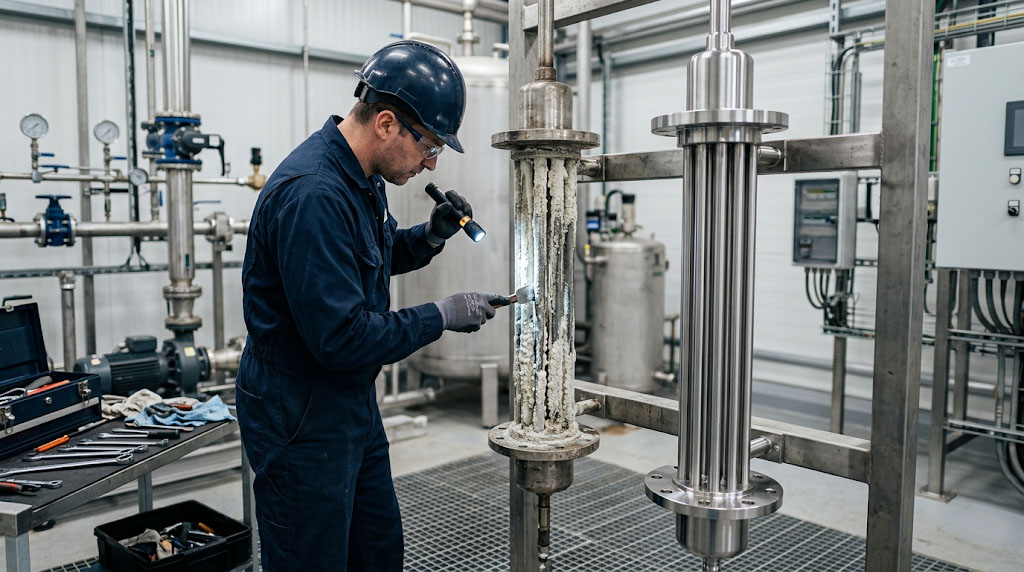
- Regular Descaling: In liquid heating, scale buildup acts as an insulator. The heat cannot escape into the fluid, causing the internal temperature to spike and the element to fail. Clean immersion heaters periodically.
- Maintain Fluid Levels: Never allow an immersion heater to run dry. Exposure to air will cause a heater designed for liquid immersion to overheat and burn out within minutes.
- Monitor for Sludge: In storage tank heating, sludge can accumulate at the bottom of the tank. Ensure your heating elements are positioned above the sludge zone to prevent overheating.
Frequently Asked Questions (FAQs) About Watt Density
What happens if the watt density is too high?
If the watt density exceeds the medium's ability to absorb the heat, the heater will overheat. In liquids, this causes boiling, scorching, or coking. Ultimately, the internal resistance wire will melt, resulting in catastrophic heater failure.
How do I calculate the heated surface area of a tubular heater?
Calculate the circumference of the tube (Diameter times pi) and multiply it by the heated length (total length minus the unheated cold zones at the ends).
What is the recommended watt density for heating heavy oil?
For heavy fuel oils and highly viscous fluids, the recommended watt density is typically very low—between 5 and 10 W/in²—to prevent the oil from carbonizing on the heater sheath.
Can I use a water heater for oil if the total wattage is the same?
No. Water heaters are designed with a high watt density (often 45+ W/in²). If you place a water heater into oil, the oil cannot absorb the heat fast enough, causing the oil to scorch and the heater to burn out rapidly.
Partner with elekheat for Custom Industrial Heating Solutions
Getting the watt density right requires a deep understanding of thermodynamics, fluid properties, and metallurgy. You don't have to guess.
At elekheat, we specialize in manufacturing premium, high-reliability heating elements tailored to your exact industrial specifications. Whether you are engineering a complex injection molding system or upgrading your storage tank heating infrastructure, our engineering team provides expert thermal calculations to ensure maximum efficiency and longevity.
Don't let poor heating specifications slow down your production. Contact the elekheat technical team today for a customized quote and expert sizing support for your next project.