Skip to content
Accurate temperature measurement is the lifeblood of efficient industrial processes. For overseas engineers, technicians, and B2B buyers, selecting the right temperature sensor can mean the difference between a highly optimized production line and costly equipment downtime. If you are dealing with complex thermal systems, you have likely asked: what is a thermocouple, and how does it integrate with professional industrial heating solutions?
In this comprehensive guide, we will break down the fundamental concepts, explore the core working principles of a thermocouple, and provide actionable advice on how to select and maintain these critical components for demanding applications like injection mold heating and industrial furnaces.
What is a Thermocouple? Core Definition and Working Principle
A thermocouple is a passive, highly reliable temperature sensor widely used across industrial applications—accounting for roughly 60% of all industrial temperature sensors. Unlike devices that require an external power source, a thermocouple relies entirely on thermoelectric physics.
The Seebeck Effect: How It Works
The core working principle of a thermocouple is based on the Seebeck Effect.
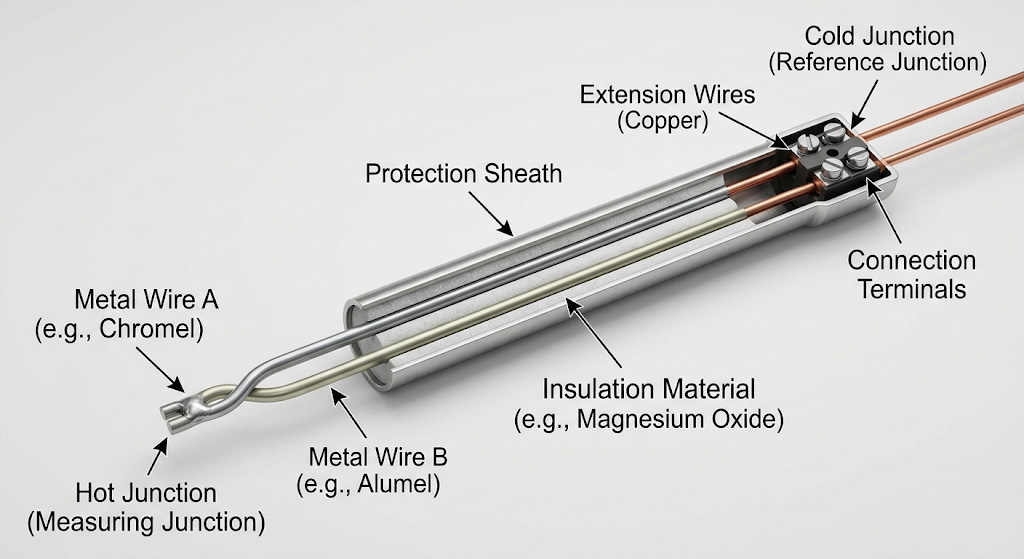
- The Setup: A thermocouple consists of two different metal wires (the thermoelements) joined together at one end to form a closed circuit.
- The Hot and Cold Junctions: The welded end is the Measuring Junction (Hot Junction), which is placed directly in the environment you want to measure. The opposite end is the Reference Junction (Cold Junction), which is maintained at a known, constant temperature (often room temperature or 0°C).
- The Voltage Generation: When there is a temperature difference between the Hot Junction and the Cold Junction, a small electromotive force (voltage) is generated within the circuit.
- The Output: This voltage is directly proportional to the temperature difference. By measuring this voltage with a connected controller or meter, and referencing standard calibration tables, the exact temperature at the measuring end can be calculated with high precision.
Basic Structure
Despite their robust performance, thermocouples feature a remarkably simple construction:
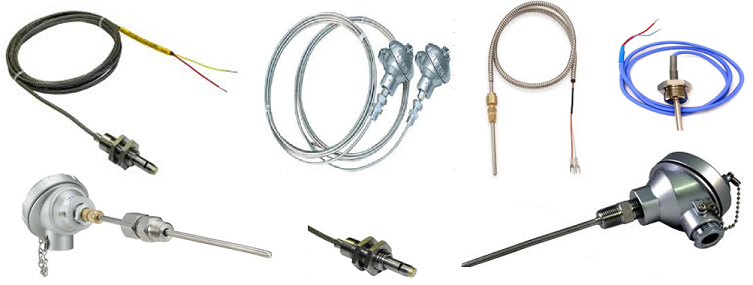
- Thermoelements: The two distinct metal wires that form the core sensing component.
- Protection Tube (Sheath): A durable outer casing (often stainless steel or Incoloy) that protects the internal wires from mechanical damage, corrosion, and harsh environments.
- Terminal Block/Head: The connection point where the thermocouple interfaces with extension wires and control systems.
Thermocouple vs. RTD: A Comparative Analysis
When designing an industrial heating system, engineers often debate between using a thermocouple and a Resistance Temperature Detector (RTD). Here is a technical breakdown to help you make the right choice:
| Feature/Dimension | Thermocouple | RTD (e.g., PT100) |
|---|---|---|
| Working Principle | Thermoelectric voltage (Seebeck Effect) | Change in electrical resistance |
| Temperature Range | Extremely Wide (-270°C to 1800°C+) | Moderate (-200°C to 600°C) |
| Accuracy & Stability | Good, but can drift slightly over time | Excellent, highly stable and precise |
| Response Time | Very Fast (especially exposed junction) | Slower (requires thermal mass to heat) |
| Durability | Rugged, highly resistant to shock/vibration | Fragile, sensitive to mechanical stress |
| Cost | Generally highly cost-effective | More expensive |
| Best Application | High-temp furnaces, Injection Mold Heating, fast-moving processes | Processes requiring extreme precision at moderate temperatures |
Core Application Scenarios: Injection Mold Heating
Thermocouples have been deployed in almost every industry requiring thermal regulation, from steel metallurgy to aerospace. For manufacturers relying on precise thermal control, their integration into specific applications is vital.
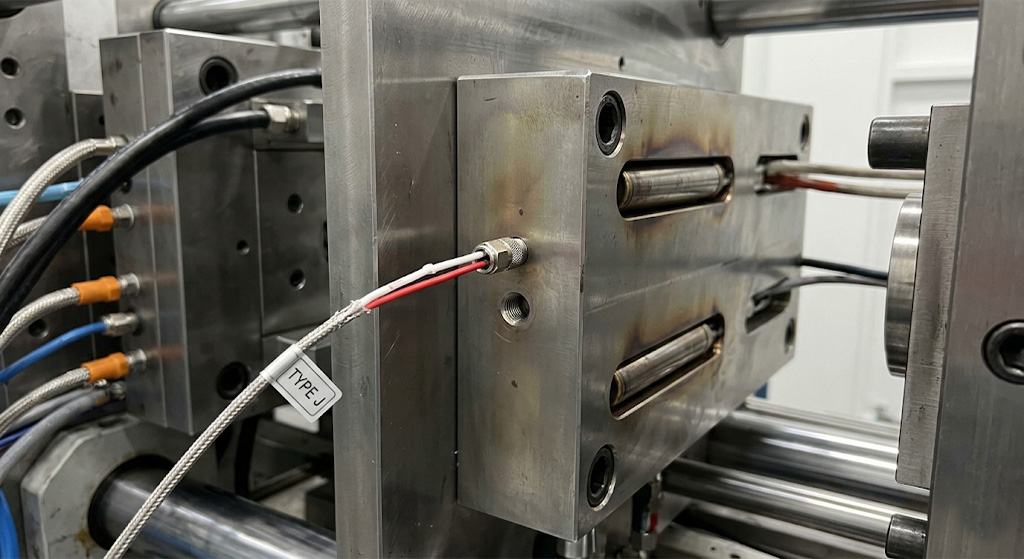
Injection Mold Heating & Hot Runner Systems In the plastics processing industry, maintaining the exact melt temperature of the polymer is critical to avoid part defects, flow marks, or material degradation.
- Rapid Response: Thermocouples (particularly Type J and Type K) offer the rapid response times required to detect sudden temperature drops when cold plastic is injected into the mold.
- Compact Integration: They can be manufactured in incredibly small diameters, allowing them to be embedded directly into heater bands, cartridge heaters, or the narrow channels of a hot runner manifold without disrupting the mold's mechanical integrity.
Essential Buying Guide: Selecting the Right Thermocouple
Not all thermocouples are created equal. Choosing the correct type ensures accurate readings and prevents premature sensor failure. Consider the following crucial factors:
1. Select the Right Calibration Type
Standardized thermocouples use specific metal combinations tailored for different environments:
- Type K (Nickel-Chromium / Nickel-Alumel): The most popular general-purpose sensor. Excellent linearity, cheap, and covers a wide range (-200°C to 1300°C). Great for oxidizing environments.
- Type J (Iron / Constantan): Highly cost-effective and ideal for vacuum, reducing, or oxidizing atmospheres up to 750°C. Highly recommended for injection mold heating and plastics extrusion.
- Type N (Nicrosil / Nisil): Similar to Type K but offers superior resistance to oxidation at high temperatures.
- Type S & B (Platinum-Rhodium): Premium sensors designed for extreme high-temperature industrial furnaces and metallurgy (up to 1800°C).
2. Determine the Junction Style
- Grounded Junction: The wires are welded directly to the protection sheath. Offers the fastest heat transfer and response time, ideal for high-pressure applications.
- Ungrounded Junction: The wires are electrically isolated from the sheath. Provides excellent protection against electrical noise and ground loops.
3. Sizing and Sheath Material
Ensure the diameter and length match your insertion depth requirements. Choose a sheath material (like 304/316 Stainless Steel or Inconel) that can withstand the specific chemical and atmospheric conditions of your application.
Maintenance and Care for Maximum Lifespan
To ensure your heating systems remain highly efficient and your readings remain accurate, follow these maintenance best practices:
- Regular Calibration: Thermocouple outputs can drift over time due to metallurgical changes caused by extreme heat. Schedule periodic calibrations against a known standard.
- Inspect the Protection Tube: Regularly check the outer sheath for signs of scaling, corrosion, or mechanical wear. A breached tube will quickly lead to wire degradation and false readings.
- Manage the Cold Junction: Ensure the environment around the reference junction remains stable. Fluctuating ambient temperatures at the terminal head can skew your measurement data.
Frequently Asked Questions (People Also Ask)
1. Can a thermocouple measure the absolute temperature of an object? No. A thermocouple strictly measures the temperature difference between its hot junction and cold junction. To display an absolute temperature, the measuring instrument must compensate for the exact temperature of the cold junction.
2. How do I know if my thermocouple is broken? The easiest method is using a digital multimeter. Disconnect the sensor and measure the resistance (ohms) across the two wires. A working thermocouple will show a very low resistance (typically 1 to 10 ohms depending on length). An infinite reading or "OL" means the internal circuit is broken.
3. What is the difference between Type J and Type K thermocouples? Type K uses Nickel alloys and is better for higher temperatures (up to 1300°C) and oxidizing environments. Type J uses Iron and Constantan, is more affordable, and is typically restricted to 750°C. Type J is heavily favored in the plastics and injection molding industries.
4. Can I use standard copper wire to extend a thermocouple? No. You must use specific thermocouple extension wire made from the same (or compatible) alloys as the sensor itself. Using standard copper wire will introduce unintended "new" cold junctions, completely corrupting your temperature reading.
Partner with elekheat for Reliable Industrial Heating Solutions
Understanding what is a thermocouple is just the first step in optimizing your industrial thermal systems. Whether you are upgrading an injection mold heating system or designing a custom industrial furnace, the reliability of your temperature sensors and heating elements directly impacts your bottom line.
As a dedicated manufacturer of industrial heating elements and technical materials, elekheat provides complete, high-performance thermal solutions for B2B clients across North America, Europe, and beyond. We understand the stringent technical requirements of international trade and offer tailored engineering support to match.
Don't let inaccurate temperature control hold your production back. Contact the elekheat engineering team today to discuss your specific requirements, get a customized quote for industrial heating elements and sensors, and secure a reliable supply chain partner.