 Skip to content
After two decades of manufacturing heating elements, I’ve seen a single misplaced specification wipe out a batch of heaters in weeks—whether it’s a cartridge heater in an oversized bore, an immersion heater in the wrong chemistry, or a finned air heater suffocating behind a clogged filter. This guide walks you through 14 common heating element types from an engineering and field-service perspective. The goal is to help you match the element to the operating environment, not just the wattage.
The Difference Between a Heating Coil and a Heating Element
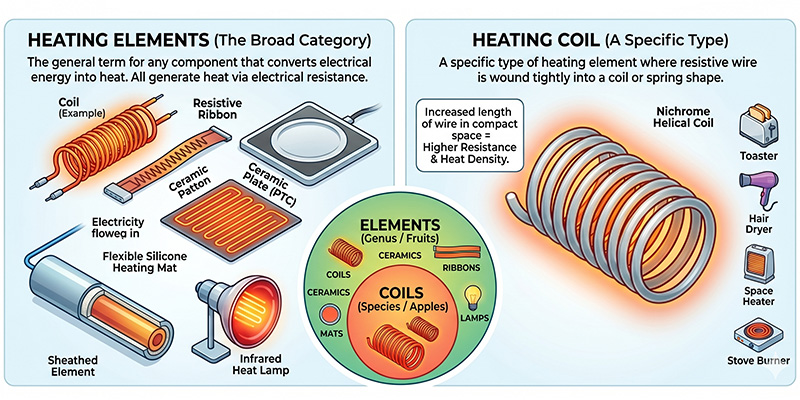
On the shop floor, a heating coil is the bare resistance wire—nichrome or FeCrAl—wound to a target resistance. A heating element is the complete, engineered assembly: coil, compacted MgO insulation, metal sheath, lead wires, seals, and mounting fittings. When maintenance orders a replacement, they’re buying a tested, hermetically sealed device. Heat transfer, dielectric strength, and corrosion resistance depend on the sheath and insulation system, not just the wire inside.
Power generation follows Joule’s law, P = I²R. But in practice, the limiting factor is almost never the wire melting—it’s the sheath’s ability to move heat into the process without exceeding its own material limits.
How We Evaluate an Application on the Factory Floor
Before recommending a heater type, our applications team runs through this checklist:
- Medium: Still or forced air? Water, oil, viscous fluid, corrosive chemical, or metal contact?
- Maximum sheath temperature, not just process setpoint.
- Chemical exposure: Chlorides, acids, alkalis, cleaning agents, high-purity requirements.
- Physical constraints: Insertion depth, bore diameter, bend radius, mounting clearance.
- Watt density ceiling: How many W/cm² can the medium absorb without boiling, coking, or damaging the sheath?
- Thermal cycling: Frequent on/off accelerates fatigue in the resistance wire and insulation.
Skipping this step leads to preventable failures. We’ve replaced finned air heaters that were installed in condensate tanks, and 304 stainless immersion heaters that lasted three weeks in a mild sulfuric acid rinse. Matching the type to the environment prevents those calls.
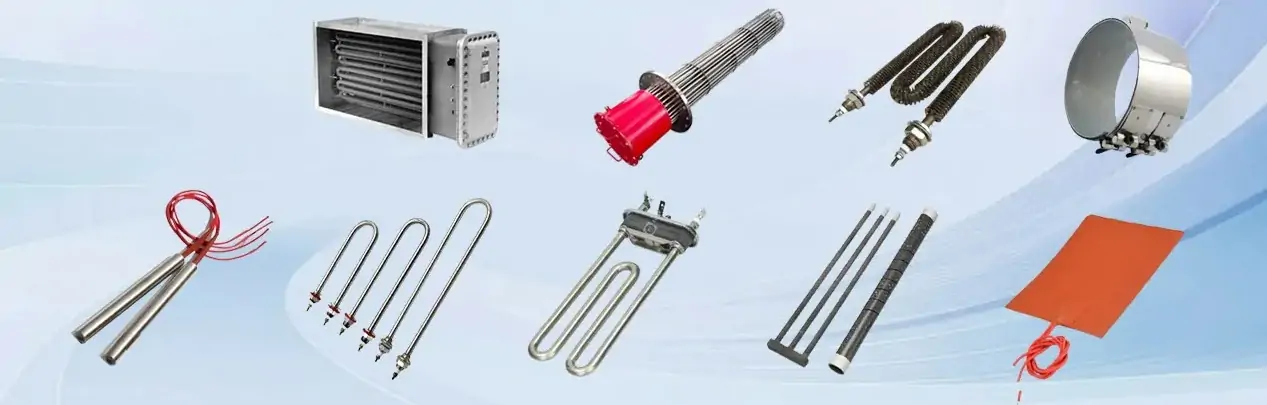
14 Heating Element Types at a Glance
Use this table as a plant-floor reference. Watt density ranges are typical; always check the manufacturer’s limits for your specific medium and temperature.
| Type | Common Sheath Materials | Max Sheath Temp (°C) | Typical Watt Density (W/cm²) | Best For | Field Notes |
|---|---|---|---|---|---|
| Cartridge Heater | 304/316 SS, Incoloy 800 | 760 | 0.8–15 (into metal) | Platens, molds, sealing bars | Bore clearance 0.05–0.10 mm over sheath OD; oversize bore causes internal overheat and open circuit. |
| Immersion Heater (screw plug/flange) | 316 SS, Incoloy, Titanium | 650 (oil), 200 (water) | 2–8 (water), 1–4 (oil) | Tanks, boilers, CIP systems | Low-level cutout is mandatory. Dry-fire destroys the sheath in under a minute. |
| Tubular Heater (formed) | 304/316 SS, Incoloy | 750 | 2–6 (air), 5–10 (liquid) | Ovens, duct heaters, fryers | Minimum bend radius 3× sheath diameter. Tighter bends crack MgO and create hotspots. |
| Finned Tubular Heater | SS tube with steel/SS fins | 400 (in air) | 2–5 | Air heating, drying cabinets | Match fin spacing to airflow. Tight fins in dirty air clog and overheat. |
| Open Coil Heater | Nichrome wire, no sheath | 1100 | 10–20 (high airflow) | Fast-response air heaters | Electrically live; dust buildup leads to arcing. Proper guarding essential. |
| Band Heater | Mica or ceramic-insulated, SS sheath | 480 (mica), 650 (ceramic) | 3–7 | Barrel heating, extruders | Torque clamps to 15–20 N·m. Over-tightening crushes insulation. |
| Strip Heater | 304 SS sheath, MgO insulation | 540 | 3–8 | Platen, hopper, surface heating | Fill air gaps with thermal paste; a 0.2 mm gap cuts heat transfer by 50%. |
| Mica Strip Heater | Mica-insulated, galvanized steel | 480 | 2–5 | Low-temperature surface heating | Keep dry. Mica absorbs moisture and swells, causing insulation failure. |
| Silicone Rubber Heater | Fiberglass-reinforced silicone | 260 | 0.3–1.5 | Tank wrap, drum heating, freeze protection | Surface prep: clean with IPA, target Ra 1.5–3 µm for adhesive bonding. |
| Etched Foil Heater | Polyimide or silicone laminate | 200 (polyimide), 260 (silicone) | 0.5–2 | Semiconductor, medical, precision instruments | Uniformity ±2% achievable. Custom foil patterns eliminate cold edges. |
| PTFE Heater | PTFE-encapsulated element | 260 | 0.5–2 | Chemical baths, semiconductor etching | Chemically inert to most acids. Mechanically fragile; avoid flexing. |
| Quartz Infrared Heater | Quartz tube, tungsten or nichrome wire | 800 (medium-wave) | 5–20 | Rapid drying, thermoforming, curing | Clean reflector every 500 hours; dust film drops IR output up to 30%. |
| Cast-in Heater | Cast aluminum or bronze with tubular element | 450 (aluminum), 650 (bronze) | 1–5 | Extruder barrels, injection molding | Non-repairable, cannot be re-bent. Order exact geometry. |
| Explosion-Proof Heater | Heavy-wall SS or Incoloy with flame path | 600 | Depends on medium | Refineries, paint booths, solvent storage | Maintain flame path dimensions per ATEX/IECEx; never field-weld the housing. |
Engineering Insights: What Really Determines Heater Life
From thousands of returned elements, we’ve learned that service life is determined by the intersection of material selection, installation quality, and operating conditions—regardless of the heater type.
Immersion Heaters: The Liquid-Level Trap
An immersion bundle that runs even partially uncovered fails fast. The exposed section’s sheath temperature skyrockets, the MgO cracks, and moisture ingress follows. We’ve seen 18 kW screw-plug heaters destroyed within a single shift because a tank’s low-level switch was bypassed during cleaning. Every immersion installation must have a verified, hard-wired low-level cutout. Additionally, scale buildup on the sheath acts as an insulator. In hard water areas, we recommend derating watt density by 20% and scheduling descaling based on water hardness, not just time.
Finned and Open-Coil Air Heaters: Airflow Is Everything
A finned tubular heater rated for 5 W/cm² with 3 m/s airflow will glow red and sag if a blower VFD ramps down to 1 m/s. We’ve measured sheath temperatures jumping from 350°C to over 700°C within seconds of airflow loss. Always interlock the heater contactor with an airflow switch or current sensor on the blower motor. For open-coil designs, dust accumulation is a hidden arcing risk; in packaging areas with paper dust, we specify washdown-rated finned elements instead, even though the upfront cost is higher.
Silicone Rubber and Etched Foil Heaters: The Bond Line Matters
For externally mounted tank and drum heaters, the adhesive bond or mechanical clamping pressure defines thermal performance. A silicone rubber heater applied to an oily, unroughened surface will delaminate within months. We require an IPA-wiped surface with a roughness of Ra 1.5–3 µm. For etched foil heaters used in semiconductor tooling, the flatness of the mounting surface is critical—a 0.05 mm air gap under a high-watt-density foil creates a hotspot visible on a thermographic scan within minutes.
Quartz Infrared: Reflector Maintenance Is Not Optional
In thermoforming and paint curing lines, IR output degrades silently. Dust and overspray on the reflector reduce radiant efficiency by up to 30% before the operator notices longer cycle times. We recommend cleaning reflectors every 500 operating hours and replacing quartz tubes when the filament shows visible sag or the ends show white devitrification, which increases the risk of rupture.
Explosion-Proof Heaters: The Flame Path Is Sacrosanct
An explosion-proof heater’s flame path—the precisely machined gap between the housing and the terminal enclosure—is what prevents an internal ignition from propagating outside. In the field, we’ve seen maintenance teams apply thread sealant to flame path threads, or even tack-weld a loose terminal housing. Both actions nullify the certification. Any field modification to an explosion-proof enclosure must be followed by a full recertification inspection.
Maintenance Schedules That Work in Practice
Adjust these intervals based on your environment. Dirty, high-temperature, or high-cycle applications demand the heavy-duty schedule.
| Maintenance Task | Light-duty (clean, <200°C) | Heavy-duty (dirty, >300°C, frequent cycling) |
|---|---|---|
| Visual inspection of sheath for blistering, pitting, cracks | Every 2000 hours | Every 500 hours |
| Insulation resistance test (megger) at 500 VDC | Every 4000 hours | Every 1000 hours |
| Thermography scan of element and connections | Every 4000 hours | Every 1500 hours |
| Torque check on terminal screws and clamping hardware | Every 4000 hours | Every 2000 hours |
| Clean fins, reflectors, or filter screens | Every 1000 hours | Every 300 hours |
| Insertion bore/thermowell diameter check | At every replacement | At every replacement |
| Scale thickness measurement on immersion heaters | Every 2000 hours | Every 1000 hours |
Common mistake: Using a standard multimeter to test insulation resistance. A multimeter only confirms no direct short. A megger at 500 VDC reveals moisture ingress or MgO degradation at operating voltage. If the hot IR reading drops below 1 MΩ, schedule replacement.
Troubleshooting Heating Element Failures: Patterns from Our Returns Lab
We analyze every returned element. The root causes cross heater types:
-
Open circuit
- Typical cause: Overheating from poor heat transfer—oversized bore (cartridge), low liquid level (immersion), blocked airflow (finned/open coil).
- Check: Bore/thermowell dimensions, liquid level controls, airflow sensors, sediment buildup.
- Fix the root cause first. A new element in the same faulty environment will fail identically.
-
Ground fault
- Common sources: Moisture ingress at leads, pinhole corrosion in immersion sheaths, cracked MgO from tight bends in tubular elements, swollen mica in strip heaters.
- Prevention: Drip loops on wiring, silicone boots on terminations in washdown areas, proper bend radii.
-
Sheath corrosion or blistering
- Root cause: Mismatched sheath alloy to process chemistry or exceeding the material’s oxidation limit.
- Solution: 304 SS pits in chlorides above 60°C—switch to 316L or Incoloy. Strong acids demand PTFE or titanium. High-temperature air requires Incoloy.
-
Localized hotspot
- Symptom: Failure at lead junction, bend, or edge of a foil/film heater.
- Root cause: Poor MgO compaction, tight bend radius, or uneven mounting pressure.
- What we do: Crimp pull-testing and X-ray sampling on sheathed elements; flatness verification on foil heater platens.
-
Thermal cycling fatigue
- Symptom: Mid-coil wire break after months of normal operation.
- Mitigation: Reduce watt density by 10–15%, implement soft-start ramp control, or specify a coil pitch designed to absorb expansion stress.
Choosing a Replacement: A 4-Step Process That Reduces Repeat Failures
When a customer calls to reorder, we don’t take the part number immediately. We ask:
- What is the exact failure mode? Open, grounded, or corroded? This points to thermal, electrical, or chemical root cause.
- What are the current installation measurements? Bore/thermowell ID, tank chemistry, airflow rate, mounting surface flatness.
- Have operating conditions changed? New cleaning chemistry, faster cycle time, different product viscosity.
- Can we de-rate by 10–15%? A small watt density reduction often doubles life without affecting cycle time.
This process has reduced repeat failures by over 60% across cartridge, immersion, air, and flexible heater applications.
Future-Ready Features in Heating Elements
We’re embedding thermocouples at the sheath tip of immersion and cartridge elements for ±1.5°C direct temperature feedback, eliminating the lag of external thermowells. RFID tags on elements store manufacturing data and trigger replacement alerts based on actual operating hours. In materials, a new MgO formulation with 15% higher thermal conductivity enables the same wattage at a 20°C lower internal wire temperature—benefitting everything from high-density cartridge heaters to large flanged immersion bundles.
Frequently Asked Questions (Engineer to Engineer)
1. What’s the difference between a cartridge heater and a tubular heater?
A cartridge heater is swaged for high-density MgO compaction, designed for insertion into a close-clearance hole for conductive heat transfer. A tubular heater is larger in diameter, can be field-bent, and is used in air, liquids, or cast into metal. Cartridge heaters tolerate higher watt densities in metal contact, but tubular heaters offer more flexibility in routing.
2. How do I calculate the required wattage for a tank immersion heater?
Q = m × Cp × ΔT / (efficiency × time) plus tank surface losses Q_loss = U × A × (T_medium – T_ambient). For 500 L of water from 20°C to 80°C in 2 hours at 85% efficiency, you’ll need roughly 24 kW plus surface losses. Add 15–20% margin but never exceed the manufacturer’s maximum watt density for the liquid to prevent local boiling or coking.
3. Why do my immersion heaters keep failing on the same tank?
Check for sediment scale insulating the sheath, intermittent low-liquid-level events, or a new cleaning chemical that has altered the corrosivity of the bath. We’ve also seen failures caused by a failing contactor that chatters, creating thermal cycling on the element with each chatter event.
4. Can I use the same finned tubular heater in still air and moving air?
No. Finned elements rely on forced convection to remove heat from the fins. In still air, the sheath temperature will quickly exceed its rating. Always interlock the heater circuit with an airflow proving switch.
5. What sheath material should I use for a mildly acidic solution?
For pH 4–6 organic acids under 60°C, 316L stainless steel is adequate. For mineral acids like sulfuric or hydrochloric, titanium or PTFE-encapsulated elements are required. Never use 304 SS in any chloride-containing solution above ambient—pitting can start within 100 hours.
6. How often should we test insulation resistance?
Every 2000 hours in clean environments, every 1000 hours in high-moisture or dirty settings. Track the trend; a declining IR indicates moisture or MgO degradation and lets you schedule replacement during planned downtime.
7. Are silicone rubber heaters suitable for outdoor use?
Yes, with proper sealing. Specify integral moisture seals on the termination, use a full-coverage adhesive bond to prevent water from wicking under the heater, and protect the leads with a weatherproof junction box. UV exposure can degrade unreinforced silicone over years; consider a UV-resistant coating for long-term outdoor installations.
Recommended Next Steps
If you’re specifying new elements or diagnosing repeat failures, our applications team can review your bore drawings, tank chemistry, airflow profiles, or mounting surface specifications. Submit your heater specification form or browse our selection guides for standard dimensions and performance data. We also offer no-charge failure analysis on returned elements, including insulation resistance trending and sheath metallography, to help you find the true root cause.
