Skip to content
For procurement managers and plant maintenance engineers, buying an industrial tank heater is rarely about understanding theoretical thermodynamics. It is about avoiding three operational disasters: undersizing a heater so the tank never reaches temperature in winter, oversizing it so it degrades expensive chemicals, or submitting a vague Request for Quote (RFQ) that causes weeks of manufacturer delays.
This guide skips the textbook formulas you can find anywhere and focuses on the real-world engineering trade-offs, common calculation blind spots, and practical procurement steps needed to get the right heater the first time.
The Mass Heat-Up Blind Spot: Why "Water Math" Fails for Chemicals
Engineering Notes: The Danger of Specific Gravity
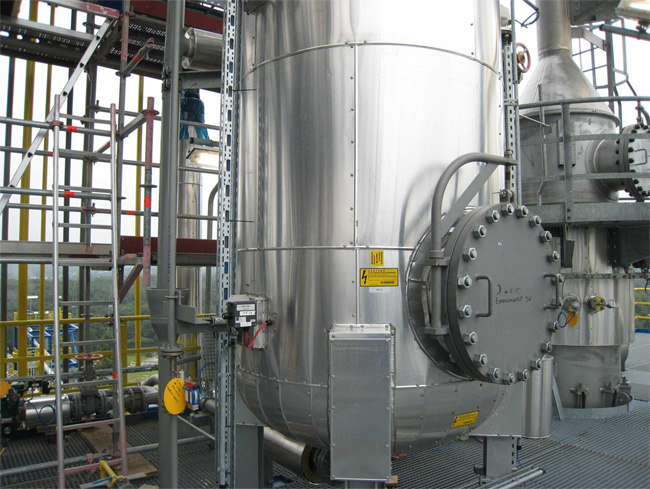
When calculating the raw power needed to heat a liquid mass, many standard online calculators assume you are heating water. In the field, we repeatedly encounter issues where heaters underperform because the chemical's density and specific heat capacity were treated as identical to water.
For instance, a 50% caustic soda (NaOH) solution has a specific gravity of roughly 1.53, meaning it is 53% heavier than water per gallon. Conversely, its specific heat capacity is only about 75% that of water. If you quote a heater based on water metrics, your calculations could be off by more than 30%, leading to a system that either fails production deadlines or burns out early.
To calculate the core heating load properly, you only need one basic relationship, which WordPress renders smoothly without formatting errors:
[latex]text{Startup Power (kW)} = frac{text{Liquid Mass (kg)} times text{Specific Heat (kJ/kg·K)} times text{Temperature Rise (°C)}}{text{Required Time (Seconds)}}[/latex]
Engineer's Decision: Sizing Active vs. Cold Length
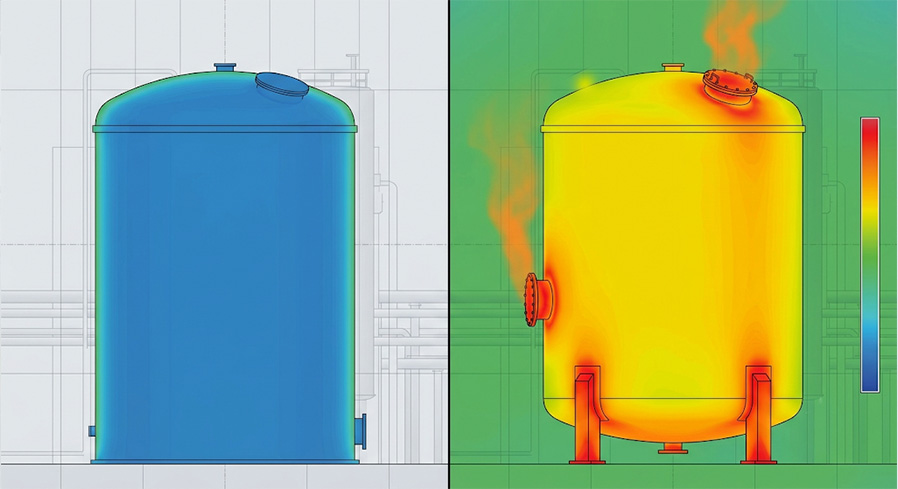
A common mistake in tank heater design is failing to specify the "unheated zone" or cold length. Electric immersion heaters rely on the surrounding liquid to draw heat away from the elements.
If your tank's liquid level fluctuates during daily batch processing and drops below the active heating element zone, the exposed elements will rapidly overheat in open air, leading to immediate sheath rupture.
Our Rule of Thumb: Always design the heater's cold length to extend at least 6 inches above the absolute lowest possible liquid level during operation.
Wind vs. Ambient: Managing Real-World Heat Loss
Factory Tips: The Wind Velocity Multiplier
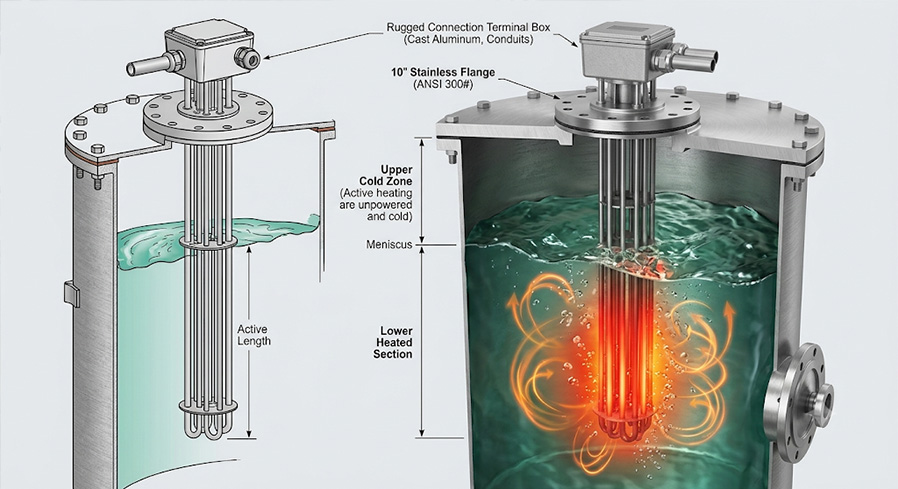
When an outdoor chemical storage tank loses temperature in winter, the primary culprit is almost never the ambient air temperature alone—it is wind velocity.
Air is a poor conductor of heat, but wind continuously strips the thermal boundary layer off the tank surface. A 25 km/h wind increases convective heat loss by up to 400% compared to still air at the exact same temperature.
[latex]text{Maintenance Heat Loss (kW)} = frac{text{Overall Heat Transfer Coefficient} times text{Tank Surface Area} times text{Temperature Delta}}{1000}[/latex]
Customer Mistakes: The "Hot Bridge" Oversight
We frequently audit insulated tanks where the client complains the temperature drops overnight. While the main tank shell has 50mm of high-quality insulation, the tank nozzles, manway covers, and structural steel support legs are completely bare.
These uninsulated metal components act as thermal black holes, pumping heat out into the atmosphere.
Procurement Tip: When writing your RFQ, do not assume a standard 1.15 safety factor covers outdoor elements. If the tank is outdoors and subjected to high winds, mandate a safety factor between 1.25 and 1.30 to account for these uninsulated structural hot bridges. However, never exceed a 1.30 safety factor blindly; oversizing the total wattage excessively without localized controls creates extreme boundary layer temperatures that cook sensitive chemicals.
Why Mixing Allows Higher Watt Density (And Lowers Your Bill)
Design Review: Surface Watt Density Explained
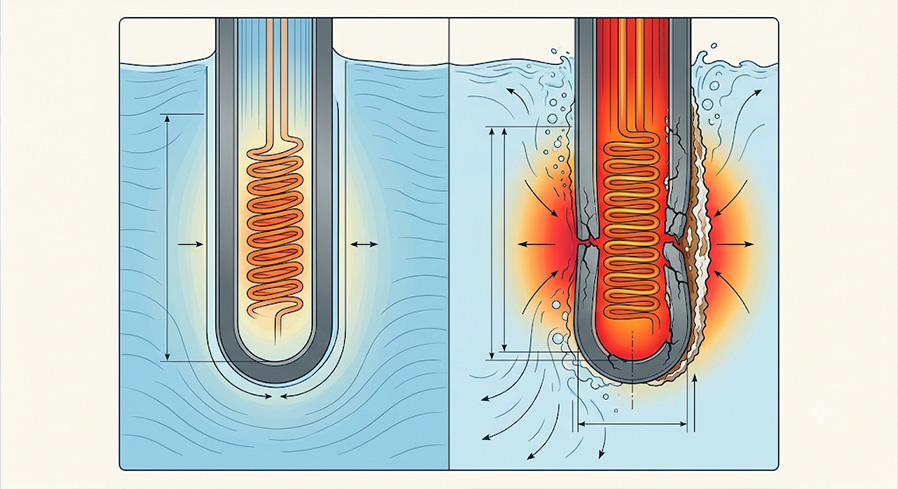
Surface watt density is the amount of electrical power discharged per square centimeter of the heater element's sheath surface.
[latex]text{Watt Density (W/cm}^2text{)} = frac{text{Element Power (W)}}{pi times text{Element Diameter (cm)} times text{Active Length (cm)}}[/latex]
If the watt density is too high for a specific chemical, the fluid directly touching the heater sheath will exceed its thermal degradation point, causing crystallization, scaling, or carbon coking. This carbon layer acts as an insulative blanket, trapping heat inside the element until it suffers catastrophic internal failure.
Why Does Mixing Allow Higher Watt Density?
- Efficient Heat Transfer: When an agitator moves liquid rapidly across the heater sheath, it carries heat away from the element surface far more efficiently than stagnant natural convection.
- Lower Sheath Temperatures: Instead of heat building up into a localized hot zone around the element bundle, the thermal energy is instantly swept into the bulk liquid.
- Smaller Footprint, Lower Cost: Because the sheath stays cooler under forced convection, engineers can safely design the heater with a much higher watt density. This allows you to specify a shorter immersion length and fewer elements, significantly reducing the initial purchase price of the flange bundle.
Safe Materials and Watt Density Guide
| Chemical Media | Safe Temperature Range (°C) | Recommended Sheath Material | Max Static Watt Density ([latex]text{W/cm}^2[/latex]) | Max Agitated Watt Density ([latex]text{W/cm}^2[/latex]) | Primary Failure Mode |
|---|---|---|---|---|---|
| Caustic Soda (20%-50%) | 20 - 65 | 316L Stainless Steel / Incoloy 800 | 3.0 | 4.5 | Caustic embrittlement & scaling |
| Sulfuric Acid (98%) | 30 - 50 | Hastelloy C276 / Titanium | 1.5 | 2.5 | Accelerated high-temp pitting |
| Hydrochloric Acid (30%) | 15 - 40 | PTFE Teflon Coating / Titanium | 1.0 | 1.2 | Coating degradation & acid attack |
| Light Process Oils | 50 - 150 | Carbon Steel / 304 SS | 4.5 | 7.0 | Fluid cracking and coking |
| Heavy Asphalt / Bitumen | 80 - 180 | Carbon Steel | 1.2 | 2.2 | High viscosity heat trapping |
Procurement Guide: How to Prepare an RFQ That Suppliers Can Actually Quote
One of the main reasons chemical tank heater orders get delayed by weeks is that manufacturers receive incomplete data. If your RFQ simply states "Need a 50 kW heater for a chemical tank," the manufacturer will be forced to guess your parameters, leading to inflated safety margins, overpricing, or repetitive technical clarification meetings.
What Information Manufacturers Need
To get an accurate, competitively priced quote on the first iteration, your technical RFQ packet must include these metrics:
- Exact Chemical Composition: Do not just say "acid." Specify the exact chemical name, concentration percentage, and any trace impurities (such as chloride levels), which dictate whether the manufacturer uses standard 316L Stainless Steel, Incoloy, Hastelloy, or a specialized PTFE Teflon coating.
- Physical Dimensional Constraints: Provide the tank's inner diameter, total depth, and the maximum allowable immersion length (the "B-dimension"). The supplier needs to ensure the element bundle will not strike internal tank baffles, low-level pump suctions, or opposing walls.
- Electrical Infrastructure Availability: Clearly define your available onsite voltage (e.g., 240V, 380V, 480V) and whether it is single-phase or three-phase. Changing the voltage late in the production process requires completely rewiring the internal element circuits (Delta vs. Wye configurations).
- Hazardous Area Classification: State whether the tank sits in a safe zone or a hazardous environment requiring an explosion-proof terminal enclosure. Specify the exact classification codes, as this alters the design of the conduit entries and limits the element's maximum allowable surface temperature profile.
Common Quotation Mistakes to Avoid
- Forgetting the Control Sensor Integration: A common purchasing error is buying a high-power immersion heater bundle without ordering integrated thermowells. For industrial chemical tanks, always mandate dual-element thermowells welded directly onto the mounting flange. One sensor hooks up to your process temperature controller (like an SCR power panel), while the second must wire directly to an independent, hard-wired high-limit safety cutout to prevent catastrophic overheating if the primary controller fails.
- Ignoring Lead Time Drivers: Custom-machined heavy flanges, non-standard exotic sheath materials (like Hastelloy), and specialized pressure-vessel code stamps (like ASME Section VIII) add weeks to standard production schedules. If your timeline is tight, ask the manufacturer if substituting an over-the-side heater or utilizing standard stocking ANSI flanges can shorten the lead time.
Installation Checklist for Maintenance Engineers
Once the heater arrives at your facility, follow this field checklist before flipping the main breaker to ensure long-term operational reliability:
- [ ] 1. Megohm Insulation Resistance Check: Before wiring the terminal box, use a megohmmeter to test the insulation resistance between the pins and the outer sheath. Shipping vibrations can sometimes hairline-crack internal MgO insulation, letting moisture creep in.
- [ ] 2. Flange Gasket Verification: Ensure the gasket material matches the chemical media compatibility chart. Never reuse an old gasket on a chemical tank flange; torque the bolts evenly in a star pattern to prevent localized high-pressure leaks.
- [ ] 3. Low-Liquid Level Interlock Test: Manually trip your tank's low-level float switch or radar sensor to verify that it instantly drops the main control coil circuit power to the heater. Never rely solely on temperature sensors to detect a dry tank.
- [ ] 4. Terminal Box Conduit Drainage: When running power cables into an outdoor terminal enclosure, ensure the conduit drops below the entry hub level to create a drip loop. This simple loop prevents rain and washdown water from running down the cable straight into the electrical terminals.
Engineer's Decision: Real-World Commissioning and Troubleshooting
What to Do When the Heater Trips the High-Limit Switch
During initial commissioning, you might find the heater cutting out repeatedly before the bulk liquid reaches its setpoint. A standard textbook response says your calculations are wrong. In reality, it is usually a boundary layer issue.
If your chemical is viscous and you are running the system statically, the liquid cannot clear the heat away fast enough, causing the sheath temperature to skyrocket past the safety threshold. Before calling the manufacturer to complain, try two field adjustments:
- Tune the SCR Power Controller: Instead of running the heater at 100% on/off cycles, switch the SCR to a time-proportioning or phase-angle firing mode. This reduces the average power output, softening the heat flux at the boundary layer while still maintaining steady net thermal energy delivery.
- Verify Sensor Placement: Ensure your control sensor is not buried directly inside the element bundle where it reads localized heat spikes, nor placed too far away in a stagnant dead zone where it fails to register overall tank temperature increases.
Direct electric immersion heating delivers massive efficiency returns by eliminating the piping loops, steam trap leaks, and sluggish thermal response of traditional external utility jackets. However, its long-term reliability relies entirely on matching element physics to chemical realities.
If you are drafting a complex technical specification or trying to diagnose a localized failure in an active production facility, contact our engineering group with your specific flow velocity and fluid density metrics to review your system blueprints.