 Skip to content
An immersion heater is a heating device that directly transfers heat into a liquid by placing the heating source inside the medium. Unlike indirect heating methods such as boilers or external heat exchangers, immersion heaters allow heat to be transferred much closer to the target fluid, reducing energy loss and achieving extremely high heating efficiency.
According to different heat sources, industrial immersion heaters are mainly divided into two categories: electric immersion heaters and steam immersion heaters. Although both are designed to heat liquids efficiently, their working principles are completely different.
Electric immersion heaters convert electrical energy into heat through resistance heating, while steam immersion heaters use direct steam injection and condensation to transfer thermal energy into water or other liquids.
Understanding how these two types work is essential for selecting the right heating solution for industrial tanks, process equipment, and OEM heating systems.
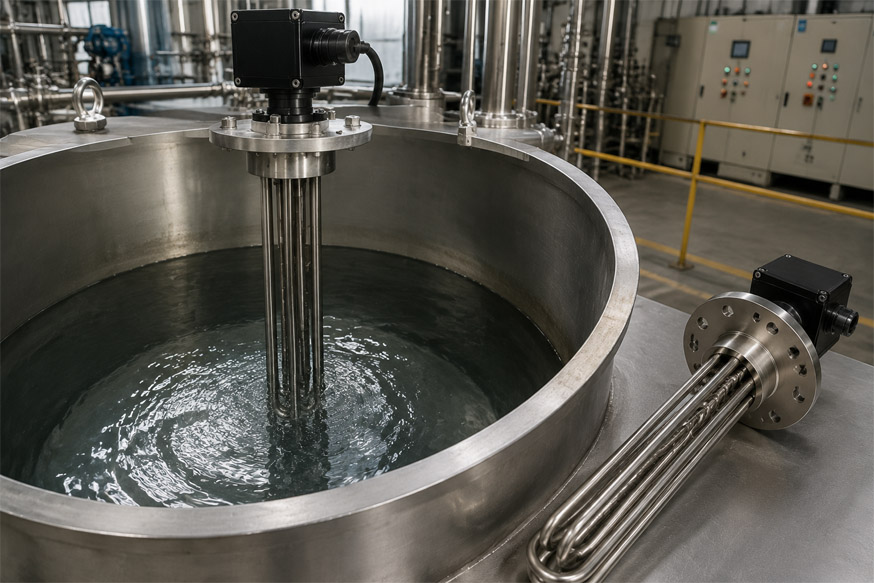
1. Electric Immersion Heater: Converting Electrical Energy Directly into Heat
Electric immersion heaters are the most widely used type of immersion heating equipment. From household water heaters to industrial process tanks, this technology follows the same basic principle: electrical energy is converted into thermal energy through resistance heating, and the generated heat is transferred directly to the surrounding liquid.
1. Core Structure
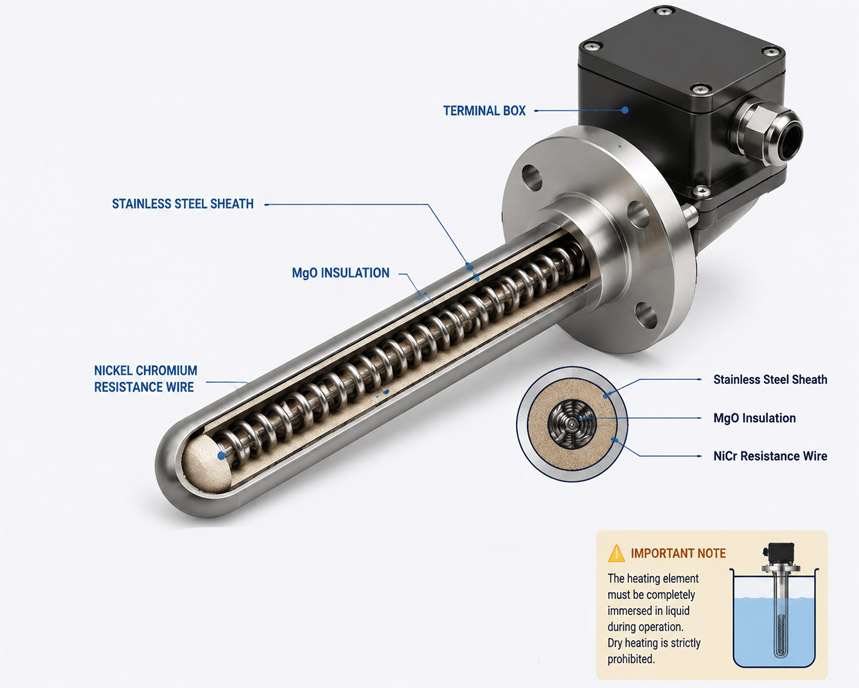
An industrial electric immersion heater mainly consists of a heating element, electrical insulation layer, metal sheath, and connection structure.
The heating element uses a high-temperature resistance wire, typically made of nickel-chromium alloy (NiCr), as the heat source. When electric current passes through the resistance wire, heat is generated through the Joule heating effect.
The resistance wire is embedded in highly compacted magnesium oxide (MgO) insulation. MgO provides excellent electrical insulation while maintaining high thermal conductivity, allowing heat to efficiently transfer from the internal heating wire to the outer metal sheath.
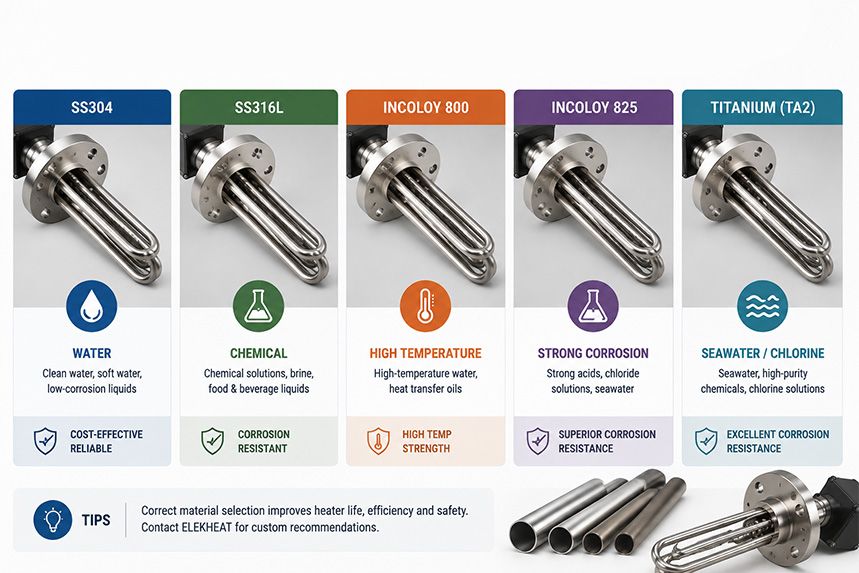
The outer sheath protects the internal components from the surrounding liquid and provides corrosion resistance and mechanical strength. Depending on the operating environment, commonly used sheath materials include stainless steel 304, stainless steel 316L, Incoloy 800, and Incoloy 825.
Industrial immersion heaters are commonly installed through flange mounting, screw plug mounting, or over-the-side installation. The heating section must remain completely immersed in the liquid during operation to prevent overheating caused by dry firing.
2. Working Process
The working process of an electric immersion heater can be divided into several stages.
① Electrical Heating
When power is supplied, electrical current flows through the internal nickel-chromium resistance wire.
Due to the electrical resistance of the alloy, electrical energy is converted into heat energy, causing the heating wire temperature to rise rapidly.
② Heat Transfer Through Insulation and Sheath
The generated heat is transferred through the compacted magnesium oxide insulation layer to the outer metal sheath.
The MgO insulation plays a critical role because it provides both electrical isolation and efficient thermal conduction.
The metal sheath then becomes the actual heat transfer surface that contacts the surrounding liquid.
③ Direct Liquid Heating
Once the sheath temperature rises above the liquid temperature, heat transfers from the heater surface into the surrounding medium.
The liquid near the heater surface absorbs heat and becomes less dense, causing it to rise naturally. Cooler liquid moves downward to replace it, creating natural convection that gradually distributes heat throughout the tank.
In applications equipped with agitators or circulation pumps, forced convection further improves heat transfer efficiency and temperature uniformity.
④ Temperature Control and Safety Protection
Industrial immersion heaters are normally integrated with temperature sensors and control systems.
The controller adjusts the heater output according to the actual liquid temperature, maintaining the required process temperature.
For safety, independent over-temperature protection devices are often installed to disconnect power when abnormal heating conditions occur. This prevents overheating, heater damage, and potential safety risks.
3. Features and Application Considerations
Electric immersion heaters offer several advantages, including high thermal efficiency, compact structure, fast heating response, and accurate temperature control.
Since electrical energy is converted directly into heat, almost all input energy is transferred to the heating medium.
They are widely used in industrial water tanks, chemical processing systems, oil heating equipment, food processing machinery, storage tanks, and OEM equipment requiring reliable liquid heating.
However, correct installation is critical.
The heated section of the element must always remain below the liquid level. If the heating area is exposed to air, heat cannot be transferred effectively, causing rapid temperature rise and possible dry-burning failure.
For different applications, selecting the correct sheath material and watt density is also important.
For example, stainless steel 316L is commonly selected for corrosive liquids, while Incoloy alloys are preferred for higher-temperature applications or aggressive chemical environments.
2. Steam Immersion Heater: Direct Steam Injection and Mixing Heat Transfer
Steam immersion heaters, also known as direct steam injection heaters or steam mixing heaters, are another important type of immersion heating system.
Unlike electric immersion heaters, they do not use electrical resistance elements as the heat source. Instead, they utilize high-temperature steam as the energy source and transfer heat through direct contact between steam and liquid.
This heating method is widely used in industrial hot water systems, process heating applications, storage tanks, HVAC systems, and facilities where a reliable steam supply is available.
1. Core Structure
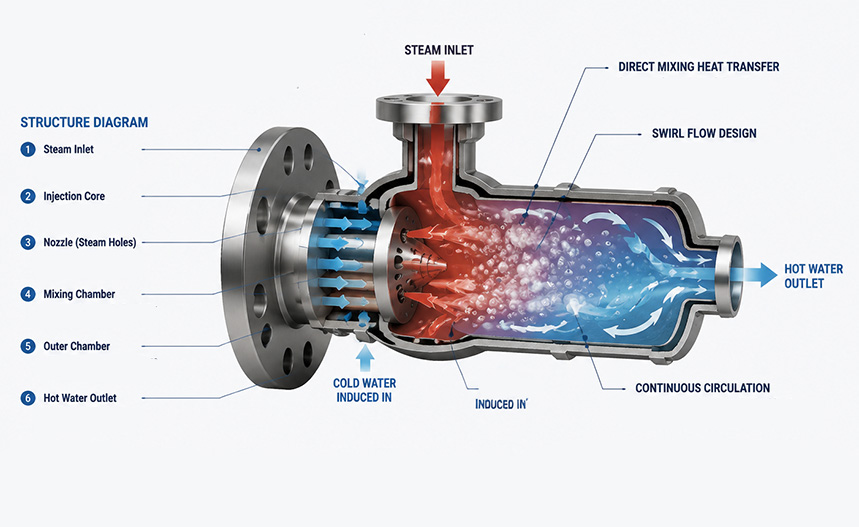
A steam immersion heater mainly consists of a steam injection core, outer chamber, connection pipe, and mounting flange.
The main components are usually manufactured from stainless steel or carbon steel depending on the operating environment and fluid requirements.
The internal injection core is the key component of the system. Its surface is designed with specially arranged small angled openings that act as steam nozzles.
These openings control the direction and velocity of steam injection, creating an efficient mixing effect between steam and surrounding water.
Unlike conventional heat exchangers that rely on metal walls for heat transfer, steam immersion heaters use direct contact heat transfer.
Steam releases its latent heat immediately when it condenses inside the liquid, allowing energy to be transferred with minimal heat loss.
2. Working Process
The operation of a steam immersion heater is based on high-speed steam injection, fluid mixing, and direct condensation heat transfer.
① High-Speed Steam Injection
High-temperature steam enters the internal injection chamber through the steam inlet.
As the steam passes through the specially designed angled holes, it is released into the surrounding liquid at high velocity.
The nozzle design creates a controlled injection direction, improving mixing performance and preventing unstable operation.
② Water Induction and Mixing
The high-speed steam flow generates a pressure difference around the injection area, creating an induction effect that draws surrounding cold water into the mixing chamber.
Steam and water come into direct contact inside the heater, allowing heat transfer to occur immediately.
③ Direct Condensation Heat Transfer
When steam contacts cooler water, it rapidly condenses and releases its latent heat.
Because the steam energy is transferred directly into the water, there is almost no heat loss associated with secondary heat transfer surfaces.
This direct mixing process allows steam immersion heaters to achieve extremely high thermal efficiency, often exceeding 99% under properly designed operating conditions.
④ Mixing, Noise Reduction, and Flow Stabilization
During operation, the injected steam creates turbulent water movement inside the heater chamber.
The specially designed internal structure guides the water flow into a controlled mixing pattern, improving heat distribution while reducing steam vibration and operating noise.
Advanced steam mixing heaters use internal flow-guiding structures to absorb steam kinetic energy and reduce the noise commonly associated with direct steam injection systems.
⑤ Hot Water Circulation
The heated water exits the heater and returns to the storage tank or process system.
As hot water rises and colder water enters the heating area, continuous circulation is created.
This process allows the entire tank volume to gradually reach the required temperature while maintaining stable temperature distribution.
3. Features and Advantages
The biggest advantage of steam immersion heaters is their extremely high energy efficiency.
Since steam transfers heat directly through condensation, almost all available thermal energy is utilized without the heat losses commonly found in indirect heating systems.
Compared with traditional steam coils or external heat exchangers, direct steam injection heating systems have a simpler structure, lower installation cost, and reduced maintenance requirements.
Another advantage is the fast heating response.
Since steam directly contacts the liquid, the system can quickly increase water temperature and respond effectively to changing process requirements.
Steam immersion heaters are especially suitable for industrial facilities that already have steam infrastructure, including factories, power plants, food processing facilities, chemical plants, and large-scale hot water systems.
However, proper operation is essential.
The water supply should be established before steam injection begins to prevent unstable operation and potential equipment damage.
3. Comparison Between Electric and Steam Immersion Heaters
| Comparison | Electric Immersion Heater | Steam Immersion Heater |
|---|---|---|
| Heat Source | Electricity | Steam |
| Heating Method | Resistance heating and conduction through metal sheath | Direct steam injection and condensation |
| Heat Transfer | Indirect heat transfer through heating element surface | Direct mixing heat transfer |
| Thermal Efficiency | Very high, close to 100% | Extremely high, usually above 99% |
| Main Structure | NiCr resistance wire + MgO insulation + metal sheath | Injection core + chamber + steam nozzles |
| Installation | Flange, screw plug, or over-the-side mounting | Flange-mounted steam injection system |
| Best Application | Water tanks, oil heating, chemical liquids, OEM equipment | Large water tanks, industrial hot water systems, facilities with steam supply |
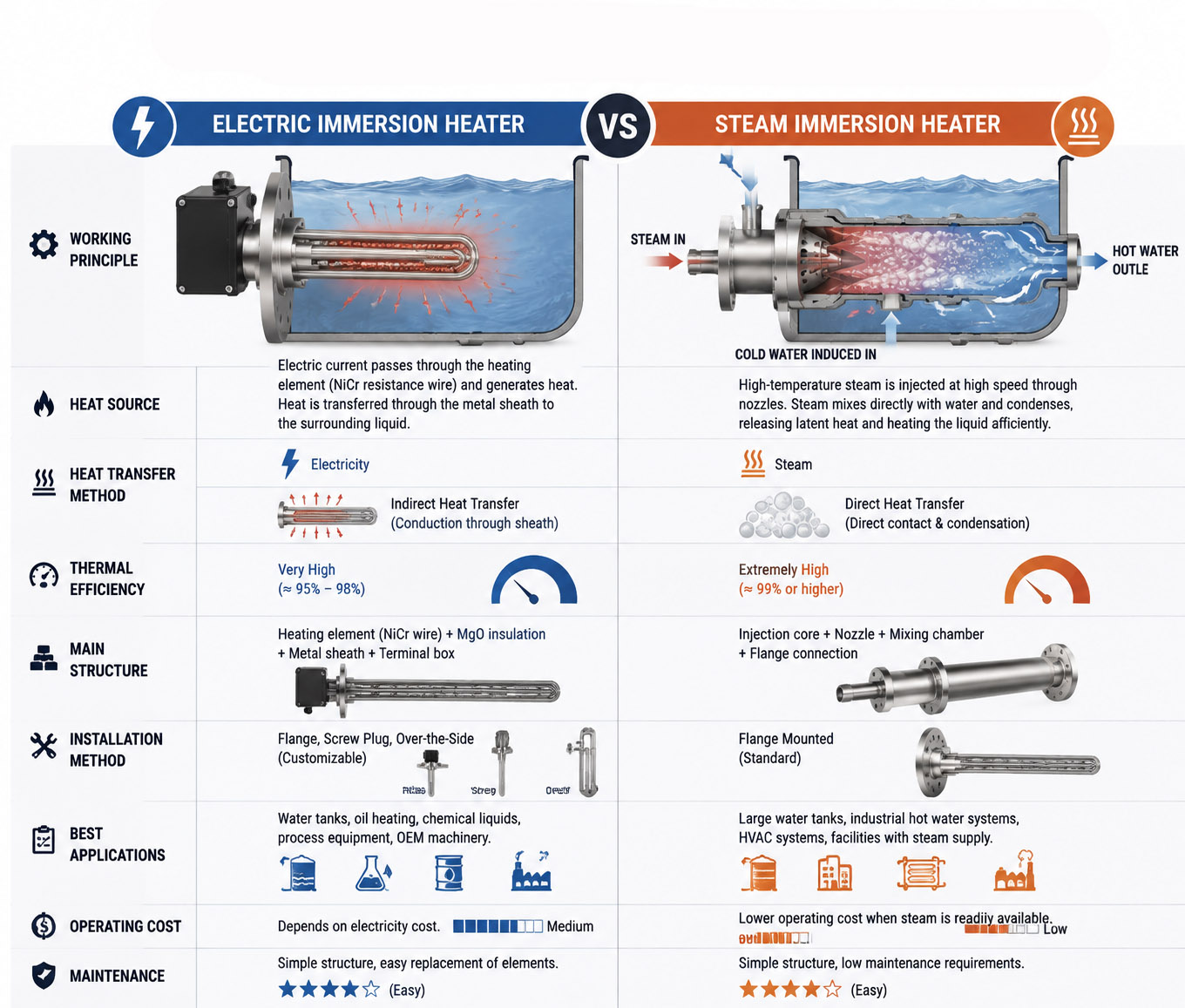
The choice between electric and steam immersion heaters mainly depends on the available energy source, heating capacity requirements, and operating environment.
When electrical power is easily available and the required heating capacity is moderate, electric immersion heaters provide a simple, flexible, and reliable solution.
When a facility already has a steam system and requires large-volume liquid heating, steam immersion heaters can provide faster heating and higher energy utilization with lower operating costs.
4. How to Select the Right Industrial Immersion Heater
Selecting the correct immersion heater requires consideration of several engineering factors, including heating medium, required power, material compatibility, installation method, and operating temperature.
The first consideration is the type of liquid being heated.
Different liquids require different sheath materials. Stainless steel 304 is commonly used for clean water applications, stainless steel 316L provides better corrosion resistance for chemical solutions, and Incoloy alloys are suitable for high-temperature applications or aggressive environments.
The required heating power must also be calculated according to the liquid volume, temperature rise, heating time, and heat loss conditions.
In industrial applications, sufficient safety margin should be considered to ensure stable heating performance.
Installation method is another important factor.
Flange immersion heaters are widely used in industrial tanks because they provide high power capacity and easy maintenance.
Screw plug immersion heaters are suitable for smaller tanks and compact equipment, while over-the-side heaters are convenient for open tanks where installation without draining the liquid is required.
For demanding industrial applications, customization is often necessary.
Manufacturers can adjust heater length, watt density, sheath material, terminal enclosure, mounting flange, and control options according to specific process requirements.
5. Applications of Industrial Immersion Heaters
Industrial immersion heaters are widely used in many industries where direct liquid heating is required.
In water heating systems, they are used for storage tanks, process water systems, cleaning equipment, and commercial hot water applications.
In chemical processing, corrosion-resistant immersion heaters provide reliable heating for chemical solutions, plating tanks, and industrial process fluids.
In oil and energy applications, immersion heaters are used to maintain oil temperature, improve fluid flow, and prevent viscosity-related problems.
In food processing and pharmaceutical industries, immersion heaters provide accurate temperature control for cleaning systems, production equipment, and temperature-sensitive processes.
Because of their high efficiency, compact design, and flexible customization options, industrial immersion heaters have become an important heating solution for OEM equipment manufacturers and industrial system integrators.
Conclusion
The working principle of an immersion heater can be summarized as follows: a heat source is directly introduced into the liquid environment, and thermal energy is transferred efficiently through either resistance heating or direct steam condensation.
Electric immersion heaters rely on resistance wires, MgO insulation, and metal sheaths to convert electrical energy into heat and transfer it into liquids.
They are widely used in applications where electricity is the primary energy source and precise temperature control is required.
Steam immersion heaters use direct steam injection and condensation to transfer thermal energy directly into water or other liquids.
They are ideal for large-scale heating systems where steam is available and maximum energy efficiency is required.
ELEKHEAT designs and manufactures customized industrial immersion heaters for water tanks, chemical processing systems, oil heating equipment, and OEM industrial applications.
With options including flange immersion heaters, screw plug immersion heaters, and customized heating solutions, ELEKHEAT helps customers achieve reliable, efficient, and long-lasting industrial heating performance.
