 Skip to content

Selecting the right cartridge heater is an important part of 3D printer hotend design and manufacturing. The heating element directly affects heat-up time, temperature stability, energy efficiency, and the overall reliability of the heating system.
For 3D printer manufacturers and industrial equipment developers, choosing a cartridge heater involves more than matching diameter and wattage. Key considerations include dimensional tolerances, active heating length, electrical specifications, sheath materials, lead wire configurations, and long-term operating conditions.
The best 3D printer cartridge heater should match the equipment's mechanical design, thermal requirements, and electrical control system. For OEM applications, these specifications should be confirmed during engineering evaluation and prototype testing before moving into mass production.
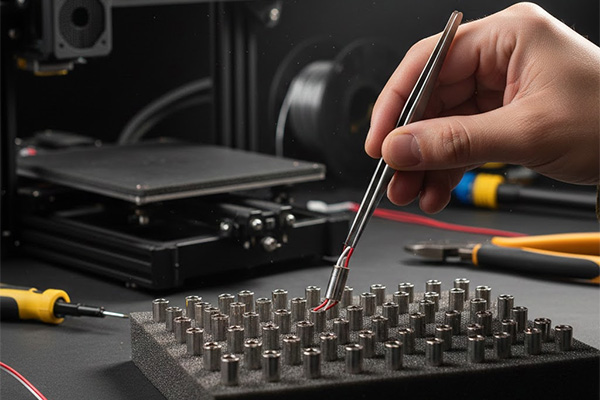
Choosing the right heating element is essential for consistent 3D printing performance. For equipment manufacturers, an unsuitable heater can lead to slow heat-up times, temperature fluctuations, excessive electrical loading, or premature component failure. A properly specified cartridge heater helps improve heating performance and supports the reliability of the finished equipment.
This guide explains the key technical specifications, engineering considerations, and procurement requirements for selecting cartridge heaters used in 3D printers and related heating equipment.
What Diameter Cartridge Heater Do You Need?
The diameter of a cartridge heater directly affects its mechanical fit and thermal contact with the hotend block. A heater that is too small may leave excessive clearance, reducing heat transfer efficiency. A heater that is too large may not fit into the installation bore or could create mechanical stress during assembly.
The correct diameter for a 3D printer cartridge heater must be determined by the hotend design and the manufacturer's dimensional specifications. Many desktop 3D printer hotends use 6mm or 8mm diameter cartridge heaters, although other sizes are available for different equipment designs.
For OEM applications, the heater outside diameter and the hotend bore dimensions should be confirmed together. Dimensional tolerances are particularly important when developing a new hotend or sourcing cartridge heaters for repeated production.
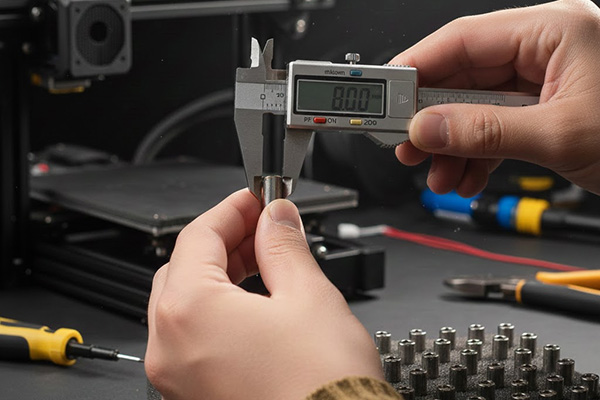
Why Diameter is So Important for Your Hotend
The relationship between the cartridge heater diameter and the installation bore affects both assembly and heat transfer.
If the heater diameter is significantly smaller than the bore, the resulting air gap can increase thermal resistance between the heater sheath and the hotend block. This may lead to slower heating, reduced heating efficiency, and less predictable temperature response.
If the heater diameter is too large, installation may become difficult or impossible. Forcing an oversized heater into the bore can damage the heater sheath, distort the installation hole, or compromise the internal insulation structure.
For equipment manufacturers, dimensional compatibility should therefore be confirmed during the mechanical design stage rather than relying on nominal dimensions alone.
At ELEKHEAT, cartridge heaters can be manufactured according to customer drawings, samples, and application requirements. When specifying a custom cartridge heater, the following dimensions should be confirmed:
- Heater outside diameter: The nominal diameter of the metal sheath.
- Diameter tolerance: The allowable dimensional variation based on the installation design.
- Hotend bore diameter: The actual machined hole size.
- Installation clearance: The required fit between the heater and the hotend block.
- Assembly requirements: Whether the heater needs to be removable for maintenance or permanently installed.
The appropriate tolerance should be determined according to the hotend material, machining process, installation method, and thermal operating conditions. There is no single tolerance that applies to every cartridge heater application.
Common Cartridge Heater Diameters
| Diameter (mm) | Common Usage | Engineering Considerations |
|---|---|---|
| 6 mm | Common in many compact desktop 3D printer hotends; used in both 12V and 24V systems. | Suitable for compact heating assemblies. The bore size and dimensional tolerance must provide appropriate thermal contact. |
| 8 mm | Used in some larger or higher-power hotends and other heating applications. | Provides a larger sheath surface area than a 6mm heater of the same length. Actual power capacity depends on the heater design and electrical rating. |
For OEM production, the diameter should be specified in the technical drawing together with its allowable tolerance. Consistent dimensional control is important when purchasing cartridge heaters in production quantities.
Do not assume that all 3D printer hotends use the same standard dimensions. Always verify the installation requirements before confirming the heater specification.
Why Does Cartridge Heater Length Matter?
The length of a 3D printer cartridge heater determines how it fits within the hotend block and how its heating section is positioned relative to the target heating area.
A heater that is too long may extend beyond the intended installation area. A heater that is too short may provide insufficient heating coverage or create an unsuitable temperature distribution.
For equipment manufacturers, it is important to distinguish between the overall heater length and the active heating length. These two dimensions are not necessarily the same.
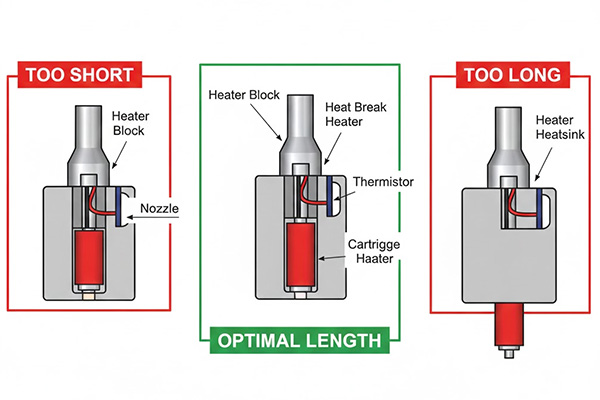
How Heater Length Impacts Temperature Uniformity
The active heating section should be positioned within the intended heated area of the metal hotend block.
If part of the active heating section extends outside the block, heat may be transferred to the surrounding air instead of the intended heating component. This can reduce heating efficiency and affect temperature distribution.
If the active heating section is too short or incorrectly positioned, the hotend block may develop temperature gradients. Depending on the thermal design, these gradients can contribute to inconsistent heating and temperature control.
For OEM applications, heater length should therefore be evaluated together with the hotend block dimensions, material, thermal mass, and temperature sensor position.
The following dimensions should be considered during cartridge heater design:
- Overall Length: The total length of the cartridge heater, including the relevant terminal configuration.
- Active Heating Length: The section containing the effective heating element.
- Cold Section: Any designated non-heated section near the lead end, depending on the heater construction.
- Lead Wire Length: The length of the electrical connection wires extending from the heater.
The internal resistance coil arrangement and the position of the active heating section should be considered during manufacturing to achieve the required heating performance.
Matching Heater Length to Your Hotend
For 3D printer manufacturers and equipment developers, the following steps help ensure that the heater length matches the mechanical design:
- Measure the bore depth: Confirm the available installation depth inside the hotend block.
- Specify the overall heater length: Make sure the heater fits within the available installation space.
- Confirm the active heating length: Ensure that the heating section is positioned within the intended heated area.
- Check the cold section: Confirm whether a non-heated section is required near the lead end.
- Consider the lead wires: Specify the required lead length, insulation type, and wire exit direction.
- Review assembly conditions: Make sure the heater can be installed and maintained without damaging the sheath or lead wires.
A properly specified heater length helps improve thermal contact, heating distribution, and compatibility with the overall hotend assembly.
How Much Power Should Your Cartridge Heater Have?
The required power rating of a 3D printer cartridge heater depends on the thermal requirements of the hotend and the electrical design of the printer.
Many standard desktop 3D printers use cartridge heaters rated between 30W and 40W. However, this range should not be treated as a universal specification for all 3D printing equipment.
For OEM applications, the appropriate wattage should be determined according to the hotend's thermal mass, target operating temperature, required heat-up time, heat losses, printing conditions, and available electrical power.
Too little power may result in slow heating or insufficient heating capacity during operation. Excessive power, on the other hand, can exceed the electrical limits of the power supply, wiring, control board, or temperature regulation system.
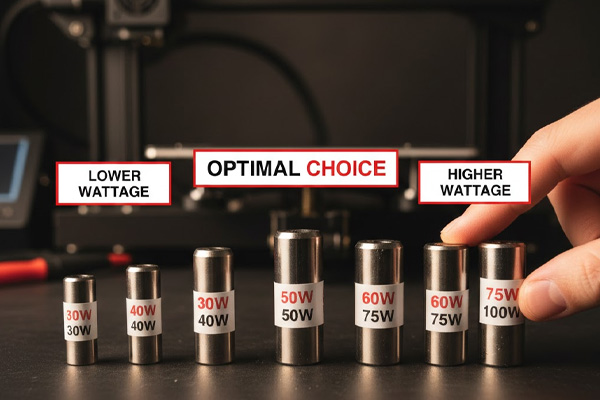
Wattage and Performance: Finding the Right Balance
Wattage directly affects the heating capacity of a cartridge heater. However, selecting a higher wattage does not automatically guarantee better temperature stability or printing performance.
For many standard desktop hotends, 30W to 40W provides a practical reference range. A 30W heater may be sufficient for a compact heating assembly with moderate thermal requirements. A 40W heater provides additional heating capacity and may reduce heat-up time or compensate for greater heat losses, provided that the complete electrical and thermal system is designed for it.
For industrial 3D printing equipment, the required power may differ considerably depending on the hotend structure, heating block material, target temperature, and operating conditions.
Calculating Cartridge Heater Power
The relationship between voltage, resistance, and electrical power is fundamental when selecting a resistive cartridge heater.
The rated power can be calculated using:
P = V² / R
Where:
- P = Electrical power (W)
- V = Rated voltage (V)
- R = Electrical resistance (Ω)
For example, a 24V, 40W cartridge heater has a nominal resistance of:
R = V² / P = 24² / 40 = 14.4 Ω
At the same nominal resistance, connecting this heater to 12V would produce approximately:
P = 12² / 14.4 = 10W
This means the heater would deliver approximately one-quarter of its rated power.
Actual resistance can vary with temperature and manufacturing tolerance, so this calculation is an approximation based on nominal electrical values.
Calculating the Required Heating Energy
For OEM cartridge heater selection, electrical power should also be considered in relation to the thermal load.
The theoretical energy required to heat a component can be estimated using:
Q = mcΔT
Where:
- Q = Required thermal energy (J)
- m = Mass of the heated component (kg)
- c = Specific heat capacity (J/kg·K)
- ΔT = Required temperature increase (K)
The theoretical average heating power can then be estimated using:
P = Q / t
Where:
- P = Average heating power (W)
- Q = Required thermal energy (J)
- t = Required heat-up time (s)
For example, if a hotend assembly has a known thermal mass and the required temperature increase is specified, the theoretical energy requirement can be calculated before selecting the heater's rated wattage.
However, the final heater rating must also account for heat losses through the surrounding structure, convection, conduction, radiation, thermal contact resistance, and operating conditions.
The calculated average power should therefore be treated as an initial engineering estimate rather than the final heater specification. Prototype testing is necessary to verify actual heat-up time and temperature stability.
Electrical System Compatibility
For OEM equipment, heater power must be compatible with the entire electrical system, including:
- Power supply capacity.
- Heating circuit current rating.
- Wiring and connector specifications.
- Mainboard switching components or external power controllers.
- Temperature sensor and control system.
- Over-temperature protection and safety interlocks.
The heater's electrical specification should be confirmed before production to avoid overloading the heating circuit.
Choosing the Right Wattage
The following table provides general reference values for common desktop 3D printer applications.
| Wattage | Heat-up Speed | Temperature Control Considerations | Power Supply Considerations |
|---|---|---|---|
| 25W | Generally slower. | May suit smaller hotends with lower heating requirements. | Confirm that the heater can maintain the target temperature under expected operating conditions. |
| 30W | Moderate. | Suitable for many standard desktop hotends. | Confirm the rated voltage and available power capacity. |
| 40W | Generally faster. | Provides more heating capacity for many standard hotends. | Check the power supply, wiring, connectors, and mainboard current limits. |
| 50W+ | Depends on the hotend design. | May suit specialized or high-flow systems designed for higher power. | Requires confirmation of electrical limits, controller compatibility, and thermal protection. |
Note: The table above is a general reference, not a universal recommendation. A higher wattage does not automatically mean better temperature stability. The appropriate rating must be compatible with the hotend, temperature sensor, control system, power supply, wiring, and safety protection.
For industrial 3D printing applications, the heater should be selected according to the equipment's actual thermal requirements rather than simply copying the specifications of a standard desktop printer.
Is 12V or 24V Better for Your 3D Printer Heater?
The rated voltage of a cartridge heater must match the voltage supplied to the hotend heating circuit.
Many modern desktop 3D printers use 24V systems, while some older or smaller machines use 12V. Industrial equipment may use other voltage configurations depending on the electrical architecture.
Using an incorrectly rated heater can result in insufficient heating or excessive power output. For OEM applications, voltage compatibility should be confirmed during the electrical design stage.

The Critical Importance of Voltage Matching
Voltage is one of the most important electrical specifications when selecting a resistive cartridge heater.
For a heater with approximately constant resistance, electrical power is proportional to the square of the applied voltage:
P = V² / R
This means that changing the applied voltage can significantly affect the heater's power output.
If a 12V heater is connected to a 24V supply, its theoretical power output may increase to approximately four times its rated power:
P₂ / P₁ = (V₂ / V₁)² = (24 / 12)² = 4
For example, a 12V, 40W heater has a nominal resistance of:
R = 12² / 40 = 3.6 Ω
When connected to 24V, its theoretical power becomes:
P = 24² / 3.6 = 160W
This is four times its rated power and can cause rapid overheating and heater failure. It may also damage the mainboard MOSFET or other electrical components that control the heater.
Conversely, a 24V, 40W heater connected to 12V would produce approximately one-quarter of its rated power:
P = 40 × (12 / 24)² = 10W
The heater would heat much more slowly and might not reach or maintain the required operating temperature.
These calculations assume approximately constant resistance and are intended to illustrate the electrical relationship. They are not recommendations for operating a heater at an incorrect voltage.
For equipment manufacturers, the rated voltage, resistance, wattage, and current should be specified together. This helps ensure that the heater is compatible with the equipment's electrical design.
Always confirm the actual voltage supplied to the hotend heating circuit rather than relying only on the printer's main power input rating.
Voltage Options and Your Printer
| Voltage | Common Printer Types | Advantages | Engineering Considerations |
|---|---|---|---|
| 12V | Used in some older or smaller desktop printers. | Suitable for systems specifically designed around 12V heating circuits. | Higher current is required than in a 24V system for the same power output. Wiring and connectors must be appropriately rated. |
| 24V | Used in many modern desktop printers. | Requires less current than a 12V system for the same power output. | Must match the heater rating and compatible control components. |
| Other Voltages | Used in specialized equipment and customized heating systems. | Allows the heater to be designed around different electrical architectures. | Requires confirmation of the power supply, control system, insulation, and safety requirements. |
For reference, a 40W heater draws approximately 3.33A at 12V and 1.67A at 24V, based on the rated power:
I = P / V
This is why voltage and wattage must be considered together. A heater with the correct wattage but the wrong voltage is not a suitable replacement.
For OEM projects, manufacturers should provide the rated voltage, rated wattage, and nominal resistance in the technical specification. These values should be checked against the equipment's electrical drawings before production.
What Materials Make a Reliable Cartridge Heater?
The materials and internal construction of a cartridge heater directly affect its electrical insulation, thermal performance, mechanical strength, and service life.
For 3D printer manufacturers, material selection should consider the hotend's operating temperature, installation environment, heating cycles, lead wire routing, and expected service conditions.
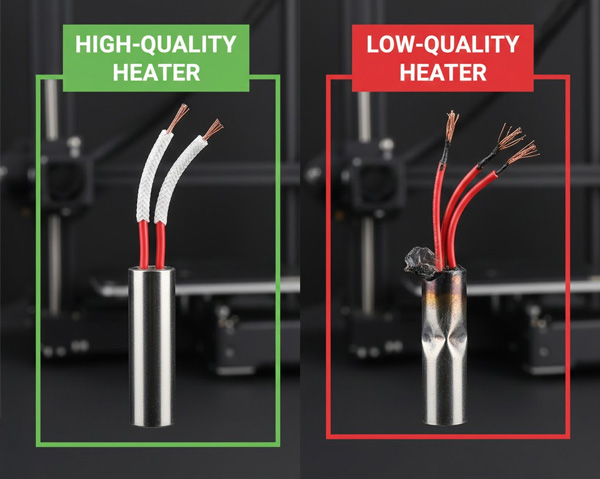
A reliable cartridge heater typically uses a suitable metal sheath, high-temperature electrical lead wires, and properly compacted magnesium oxide (MgO) insulation around the resistance element.
The Difference High-Quality Materials Make
A cartridge heater operates under repeated heating and cooling cycles. Its components must maintain suitable electrical insulation and mechanical integrity throughout the intended operating conditions.
Unsuitable lead wire insulation may become brittle, crack, or melt when exposed to temperatures beyond its rated limits. Poor internal construction can contribute to uneven heating, electrical insulation problems, and premature failure.
For OEM production, the sheath material, resistance wire, insulation, terminal construction, and lead wire system should be evaluated as a complete heating assembly.
304 Stainless Steel Casing
The outer sheath of a cartridge heater can be manufactured from 304 stainless steel.
This material offers good corrosion resistance and is suitable for many cartridge heater applications. It protects the internal heating components and provides mechanical support during normal operation.
However, 304 stainless steel is not the only possible sheath material. The appropriate selection depends on operating temperature, corrosion exposure, mechanical requirements, and the surrounding environment.
For customized cartridge heaters, the sheath material should be confirmed in the technical drawing or product specification rather than assumed from the heater's external appearance.
At ELEKHEAT, sheath material selection can be evaluated according to customer drawings, samples, and application requirements.
High-Temperature Fiberglass Lead Wires
Lead wires are another important consideration in cartridge heater design.
The wire insulation must withstand the temperatures it will encounter during normal operation. Fiberglass-insulated lead wires are commonly used in high-temperature applications, but their actual temperature limits depend on the wire construction and insulation system.
Regular PVC or nylon insulation may degrade when exposed to temperatures beyond its rated range. This can cause the insulation to become brittle, crack, or melt, creating an electrical safety hazard.
For OEM applications, the following lead wire specifications should be confirmed:
- Wire length.
- Conductor size and current-carrying capacity.
- Insulation material and temperature rating.
- Lead exit direction.
- Terminal or connector requirements.
- Protection against mechanical bending and abrasion.
The lead wire routing should also be considered during hotend design. Wires should not be exposed to temperatures beyond their insulation ratings or subjected to excessive mechanical stress.
Internal Construction
Beyond the visible sheath and lead wires, the internal construction is critical to cartridge heater performance.
A typical cartridge heater contains a resistance heating coil positioned inside a metal sheath. Magnesium oxide (MgO) insulation is used around the resistance element to provide electrical insulation and transfer heat from the coil to the outer sheath.
The resistance wire generates heat when electrical current passes through it. The heat is transferred through the compacted MgO insulation and metal sheath to the surrounding hotend block.
The quality of the internal construction depends on several factors:
- Resistance wire material and winding design.
- Resistance coil positioning.
- MgO insulation purity and compaction.
- Internal electrical insulation performance.
- Sheath construction and sealing.
- Terminal and lead wire connections.
Poorly controlled internal construction can contribute to localized hot spots, uneven heating, reduced insulation performance, and premature failure.
For equipment manufacturers, internal construction should be evaluated together with the heater's rated voltage, wattage, dimensions, and operating temperature.
Material Checklist for Your Heater
- Casing: Stainless steel, such as 304, selected according to the operating environment.
- Lead Wires: High-temperature insulation with a temperature rating suitable for the installation.
- Internal Insulation: Magnesium Oxide (MgO) with suitable electrical insulation and thermal performance.
- Resistance Element: Appropriate resistance wire material and winding configuration for the rated electrical specifications.
- Terminations: Secure electrical connections compatible with the equipment's wiring design.
Selecting appropriate materials and reliable internal construction supports safe operation, consistent heating, and the intended service life of the finished equipment.
How to Evaluate Cartridge Heater Quality and Manufacturing Consistency
For 3D printer manufacturers and OEM buyers, selecting a cartridge heater is not only about confirming its initial specifications. Manufacturing consistency and quality verification are also important, particularly when ordering production quantities.
A heater that meets the dimensional and electrical requirements of the first sample should also maintain consistent performance across subsequent production batches.
Key Quality Control and Testing Requirements
The following inspection and testing items should be considered when evaluating a cartridge heater supplier.
| Inspection Item | Purpose | Importance for OEM Applications |
|---|---|---|
| Dimensional Inspection | Checks outside diameter, overall length, and other specified dimensions. | Ensures installation compatibility and batch consistency. |
| Resistance Measurement | Verifies nominal electrical resistance. | Helps confirm electrical compatibility. |
| Power Verification | Checks whether the heater meets its specified voltage and wattage requirements. | Supports consistent heating performance. |
| Insulation Resistance Testing | Evaluates the electrical insulation between the heating circuit and sheath. | Helps identify insulation defects. |
| Dielectric Withstand Testing | Evaluates electrical insulation strength under specified test conditions. | Supports electrical safety verification. |
| Visual Inspection | Checks sheath condition, lead wires, terminals, and workmanship. | Helps identify visible manufacturing defects. |
| Heating Performance Testing | Evaluates heating response under defined test conditions. | Helps verify performance against the agreed specification. |
The applicable test conditions and acceptance criteria should be agreed upon between the customer and manufacturer according to the product design and relevant electrical safety requirements.
For OEM projects, it is also useful to confirm whether inspection records, electrical test reports, or sample evaluation results can be provided.
Prototype Testing Before Mass Production
Before placing a large production order, equipment manufacturers should evaluate the cartridge heater in the actual hotend assembly.
Prototype testing should consider:
- Dimensional compatibility: Confirm that the heater fits the installation bore correctly.
- Electrical compatibility: Verify the rated voltage, resistance, power, and current.
- Heat-up performance: Measure the time required to reach the target temperature.
- Temperature stability: Evaluate temperature regulation under representative operating conditions.
- Thermal cycling: Assess performance during repeated heating and cooling cycles.
- Lead wire performance: Check wire routing, insulation condition, and connection reliability.
Once the prototype has passed the agreed evaluation requirements, the approved specification can be used as the reference for subsequent production orders.
This approach helps reduce specification changes, assembly problems, and inconsistencies during mass production.
Standard vs. Custom Cartridge Heaters for 3D Printers
Standard cartridge heaters may be suitable for equipment with established dimensions and electrical requirements. However, manufacturers developing new hotends or specialized 3D printing equipment may require customized heating elements.
The decision between a standard and custom cartridge heater depends on the mechanical structure, heating requirements, electrical design, and production volume.
Standard Cartridge Heaters
Standard cartridge heaters are commonly selected when the equipment uses established dimensions and electrical specifications.
Typical considerations include:
- Standard outside diameters.
- Common overall lengths.
- Established voltage and wattage ratings.
- Conventional lead wire configurations.
- Existing installation dimensions.
Standard products can simplify sourcing when the application requirements match available specifications.
Custom Cartridge Heaters for OEM Applications
Custom cartridge heaters are more suitable when the equipment requires specific mechanical, electrical, or connection configurations.
Customization may include:
| Customization Item | Available Design Considerations |
|---|---|
| Diameter | Customized outside diameter according to drawings and manufacturing feasibility. |
| Length | Customized overall length and active heating section. |
| Voltage | Electrical rating based on the equipment's power supply. |
| Wattage | Power output designed around the thermal requirements. |
| Lead Wires | Customized length, insulation, and exit direction. |
| Connections | Suitable terminal and connector configurations. |
| Temperature Sensor | Integrated or coordinated temperature measurement arrangements, subject to design feasibility. |
| Sheath Material | Material selected according to the operating environment. |
For OEM projects, the customization requirements should be confirmed through technical drawings, product samples, or a detailed application specification.
Custom development should also consider manufacturing feasibility, prototype testing, and the expected production quantity.
How to Source Cartridge Heaters for 3D Printer Manufacturing
Selecting a cartridge heater supplier is an important part of the equipment manufacturing process.
For procurement managers and engineering teams, a suitable supplier should be able to understand the application, evaluate the technical specifications, and manufacture products according to the agreed requirements.
Technical Information Required for an RFQ
Providing complete technical information helps the manufacturer evaluate the application and prepare a more accurate quotation.
Before requesting a quotation, prepare the following information:
| Technical Specification | Required Information |
|---|---|
| Heater Diameter | Outside diameter (mm) and tolerance |
| Overall Length | Total heater length (mm) |
| Active Heating Length | Required heated section (mm), if specified |
| Rated Voltage | 12V, 24V, or other |
| Rated Wattage | Required power (W) |
| Resistance | Nominal resistance (Ω), if specified |
| Sheath Material | 304 stainless steel or other required material |
| Lead Wire | Length, insulation type, and exit direction |
| Temperature | Target operating temperature and operating conditions |
| Application | Hotend, extruder, or other heating system |
| Quantity | Prototype quantity and estimated production volume |
| Documentation | Technical drawing, sample, or existing product reference |
If the final design has not been confirmed, customers can provide an existing heater sample, product photograph, or preliminary drawing for technical evaluation.
Prototype Testing and Mass Production
For equipment manufacturers, prototype development should be completed before committing to full-scale production.
A typical OEM procurement process includes:
- Requirement Confirmation: The customer provides drawings, samples, electrical ratings, and application information.
- Technical Evaluation: The manufacturer reviews dimensional compatibility, heating requirements, materials, and manufacturing feasibility.
- Sample Production: Prototype cartridge heaters are produced according to the agreed specifications.
- Application Testing: The customer evaluates the samples in the actual hotend or equipment assembly.
- Specification Approval: Final dimensions, electrical parameters, and construction details are confirmed.
- Mass Production: Production proceeds according to the approved specification and agreed quality requirements.
Clear communication during these stages helps reduce design changes and supports more consistent production.
Why Choose ELEKHEAT as Your OEM Cartridge Heater Manufacturer?
ELEKHEAT is a manufacturer of industrial heating elements, providing customized heating solutions according to customer drawings, samples, and application requirements.
For 3D printer manufacturers and industrial equipment developers, cartridge heater specifications can be evaluated according to the mechanical structure, electrical requirements, and intended operating conditions.
Our customization considerations include:
Customized Dimensions and Electrical Specifications
Cartridge heaters can be specified according to customer requirements, including:
- Outside diameter and overall length.
- Rated voltage and wattage.
- Heating section configuration.
- Sheath material.
- Lead wire length and exit direction.
- Electrical connection requirements.
Application-Based Design
Different hotend designs have different heating requirements. The heater specification should therefore be evaluated according to the equipment's thermal mass, operating temperature, installation space, and electrical control system.
Providing drawings or existing samples helps establish the required configuration.
OEM and ODM Manufacturing Support
For equipment manufacturers, customized heating elements may be required for prototype development, replacement applications, or recurring production orders.
ELEKHEAT can evaluate customer requirements based on technical drawings, physical samples, and application information to determine a suitable manufacturing configuration.
For new projects, customers are encouraged to confirm the sample specifications and application performance before proceeding with production quantities.
Frequently Asked Questions
What is the most common cartridge heater size for a 3D printer?
Many desktop 3D printer hotends use 6mm or 8mm diameter cartridge heaters. However, the correct size depends on the hotend design and installation bore. Always confirm the outside diameter and dimensional tolerance before ordering.
What wattage is suitable for a 3D printer cartridge heater?
Many standard desktop 3D printers use 30W to 40W cartridge heaters. However, the appropriate wattage depends on the hotend's thermal mass, target temperature, heat losses, and electrical system. Industrial equipment may require different power ratings.
Can cartridge heaters be customized for OEM 3D printer manufacturing?
Yes. Cartridge heater specifications can be customized according to technical drawings, samples, and application requirements. Common customization options include diameter, length, voltage, wattage, sheath material, lead wire length, and connection configuration.
What is the difference between overall length and active heating length?
Overall length refers to the total length of the heater, while active heating length refers to the section that generates heat. Both dimensions should be confirmed to ensure correct positioning within the hotend block.
Which sheath material is suitable for 3D printer cartridge heaters?
304 stainless steel is commonly used for cartridge heater sheaths because of its corrosion resistance and mechanical properties. Other materials may be considered depending on the operating temperature, surrounding environment, and application requirements.
Can a 12V cartridge heater be used in a 24V system?
A 12V heater should not be connected directly to a 24V supply unless the complete heating system has been specifically designed and approved for that configuration. Applying twice the rated voltage to a resistive heater can theoretically produce approximately four times its rated power, potentially causing overheating and failure.
What information is required to order custom cartridge heaters?
The main requirements include outside diameter, overall length, active heating length, rated voltage, wattage, lead wire specifications, sheath material, operating temperature, and order quantity. Technical drawings or existing samples are also useful for confirming the design.
How can manufacturers verify cartridge heater quality?
Manufacturers should evaluate dimensional accuracy, electrical resistance, rated power, insulation resistance, dielectric withstand performance, and heating performance under defined test conditions. Prototype testing in the actual equipment is also recommended before mass production.
Request a Quote for Custom 3D Printer Cartridge Heaters
ELEKHEAT manufactures cartridge heaters according to customer drawings, samples, and application requirements. We support customized heating element specifications for industrial equipment and OEM applications.
If you are developing a new 3D printer hotend, sourcing replacement heating elements, or looking for a customized cartridge heater supplier, our team can evaluate your requirements.
To help us assess your project, please provide the following information:
- Heater Diameter: Outside diameter and required tolerance.
- Overall Length: Total heater length.
- Active Heating Length: Required heated section, if specified.
- Voltage: Rated operating voltage.
- Wattage: Required electrical power.
- Sheath Material: Required metal sheath material.
- Lead Wires: Wire length, insulation type, and exit direction.
- Operating Conditions: Target temperature and application environment.
- Order Quantity: Prototype quantity and estimated production volume.
You can also send us technical drawings, existing heater samples, product photographs, or equipment specifications for reference.
Our team can help evaluate the technical requirements and confirm a suitable manufacturing configuration before production.
Contact ELEKHEAT for OEM cartridge heater development, customized specifications, and bulk production inquiries.
