Skip to content
Choosing an industrial immersion heater is rarely a "pick the biggest wattage you can afford" decision. The same 20 kW that serves a clean-water tank for years can burn out within months inside a heavy-oil vessel, simply because the fluid, the sheath material, and the watt density were not matched. Get these three variables right and a heater runs reliably for years; get them wrong and you face scaling, coking, corrosion, and premature element failure that costs far more than the heater itself.
This guide walks through the decision in the order an engineer actually makes it: start with the fluid, then the mounting type, then the sheath material, then watt density, then the power calculation, and finally the controls and certifications you need.

Step 1: Define the Fluid First, Everything Else Follows
Every other selection step depends on one question: what are you heating?
- Water is forgiving. It conducts heat well and tolerates high watt density, but hard water brings scale.
- Oils and viscous fluids absorb heat slowly. Run them too hot and they coke onto the sheath, which insulates the element and drives it to burn out.
- Chemicals, acids, and chloride-laden fluids attack the sheath. The right material here is a corrosion decision, not a power decision.
- Air or gases barely conduct heat at all, so watt density must be kept very low and airflow maintained.
Note: Write down the fluid type, its concentration or viscosity, the required temperature, and the maximum allowable element surface temperature before you look at any heater specification.
Step 2: Choose the Mounting Type
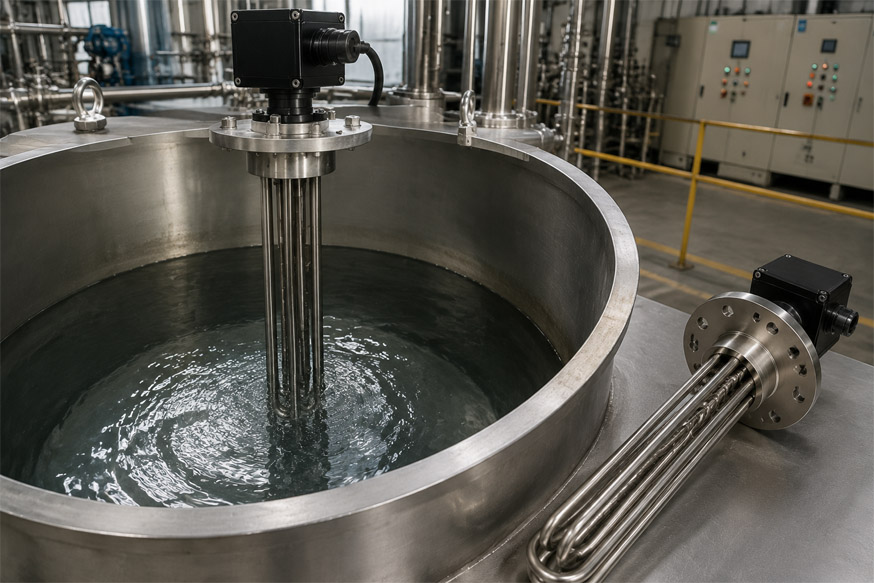
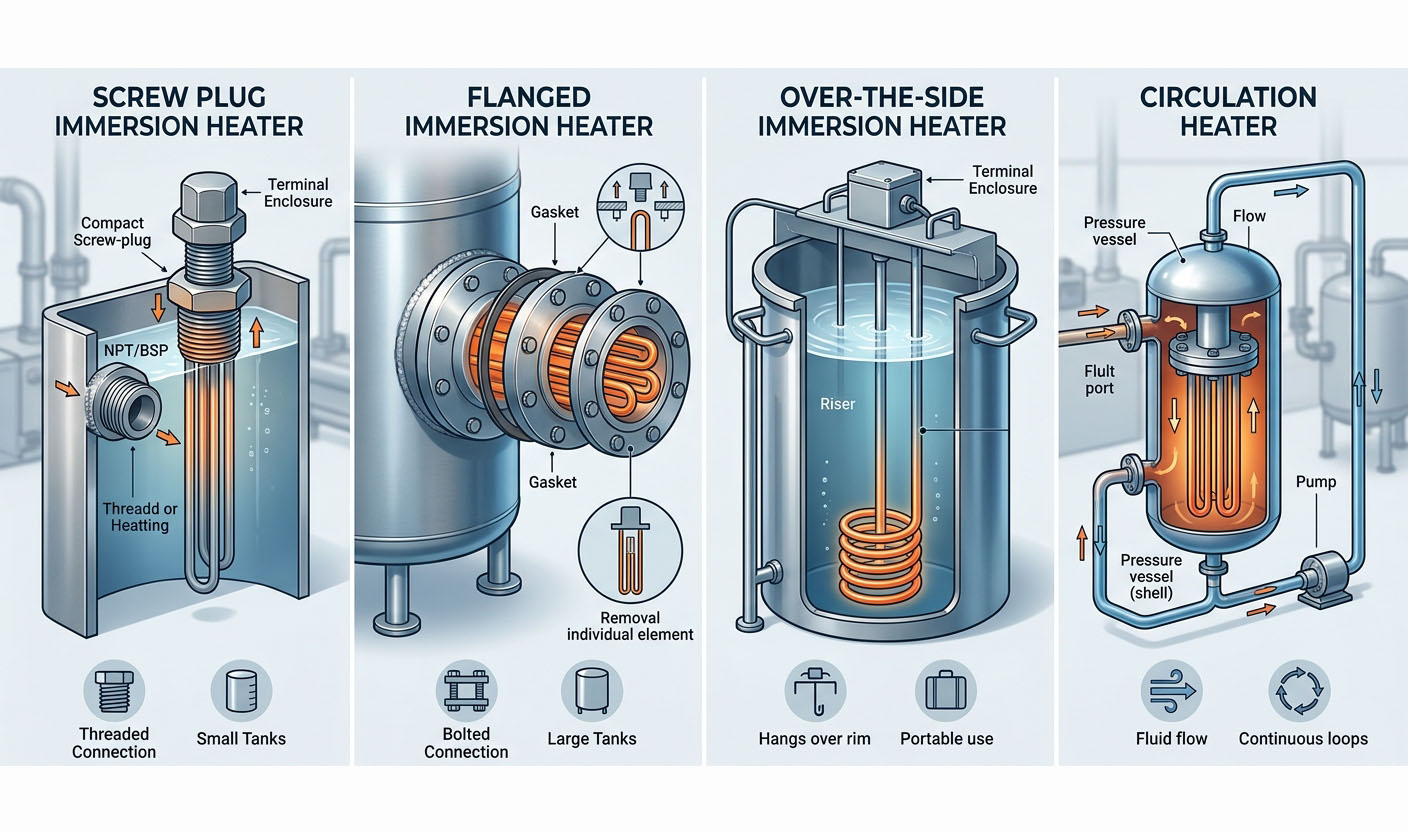
Immersion heaters all work the same way electrically, but they attach to your vessel in four main ways. Each fits a different tank situation.
| Type | How it installs | Best suited for | Typical power range |
|---|---|---|---|
| Screw plug | Threaded into an NPT/BSP boss on the tank wall | Small tanks, low-to-medium wattage, fast retrofits | 0.5 – 15 kW |
| Flanged | Bolted to a companion flange, multiple U-shaped elements | Large tanks, high wattage, easy element replacement | 5 kW – 1 MW+ |
| Over-the-side | Hangs over the tank rim, element drops into liquid | Tanks with no wall openings, portable use | 1 – 40 kW |
| Circulation | Flanged heater inside a vessel that fluid flows through | Continuous flow processes, closed-loop systems | 3 – 500 kW+ |
When you should pick which:
- Screw plug is the workhorse for existing threaded ports. Cheap to install, easy to swap, but power is limited by thread size and space.
- Flanged is the industrial standard for anything above roughly 15–20 kW. You can repair one failed tube instead of replacing the whole heater.
- Over-the-side is the retrofit answer when drilling is not an option or the heater moves between vessels. Heat loss and splashing must be managed.
- Circulation heaters pack high wattage into a compact shell for fluids that flow, suiting continuous loops.
Step 3: Match the Sheath Material to Your Fluid
The sheath is the part that actually touches your liquid, deciding corrosion resistance, maximum temperature, and heater lifespan. This is the most common source of selection error.
| Sheath material | Best for | Approx. max working temp | Notes |
|---|---|---|---|
| Copper | Clean water, mild duty | ~100°C | Excellent heat transfer, low cost; corrodes in hard/acidic water |
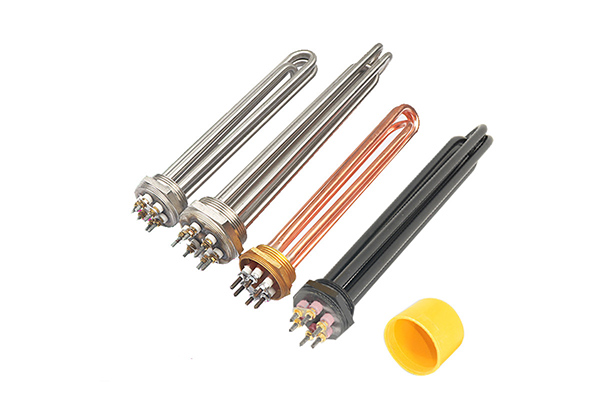
| SS304 | General water, neutral pH fluids | ~300°C | The default choice: good corrosion resistance, good value |
| SS316 / 316L | Hard water, chlorides, mild acids | ~300°C | Molybdenum content resists pitting and chloride attack |
| Incoloy 800 / 840 | Oils, high-temp fluids, corrosive service | ~600°C | Holds up at high sheath temperatures where stainless softens |
| Titanium | Aggressive chemicals, plating baths, seawater | ~200°C | Near-immune to many acids and chlorides; higher cost |
| PTFE-coated | Strong acids and alkalis at low temp | ~100°C | Chemical resistance without a metal's corrosion limits |
| Carbon steel | Fuel oil, lube oil | ~400°C | Cost-effective for oil service; oxidizes at sustained high temp |
A practical rule: if the fluid is neutral and clean, 304 is usually right. If it has heavy minerals or chlorides, step up to 316L or Incoloy. If it is a strong acid, titanium or PTFE is required.
Step 4: Set the Watt Density
Watt density is the power released per unit of sheath surface area (W/cm² or W/in²). It directly controls the sheath surface temperature. Push the watt density too high, and the following occurs:
- Too high on water: Calcium and magnesium scale forms, acting as an insulator and burning out the element.
- Too high on oil: The oil cracks and forms carbon (coking), insulating the tube and causing failure.
- Too high on air/gas: The sheath overheats and oxidizes rapidly.
Safe starting points for common fluids:
| Fluid | Recommended max watt density |
|---|---|
| Clean water | ~8 W/cm² (use ~6 W/cm² or lower for hard water) |
| Light oil | ~2 W/cm² |
| Heavy / high-viscosity oil | ~1.5 W/cm² or lower |
| Air / gases | ~1 W/cm² |
Step 5: Size the Power (kW)
You need enough power to raise the fluid to the target temperature within your time limit, plus a margin for heat loss. For water, use this estimate:
Power (kW) = (Tank volume in liters × Temperature rise in °C × 4.18) ÷ (Heating time in hours × 3,600)
Example: Heat a 1,000 L tank of water from 20°C to 80°C in 2 hours.
- Temperature rise = 60°C
- Energy needed = 1,000 × 60 × 4.18 = 250,800 kJ
- Base Power = 250,800 ÷ (2 × 3,600) = ~35 kW
- Add 15–20% for tank heat loss → specify roughly 40 kW.
For oils and chemicals, replace 4.18 with the specific heat of the fluid (typical oils sit around 1.7–2.2 kJ/kg·°C).
Step 6: Check Voltage, Phase, and Controls
- Voltage/Phase: Must match your site supply (e.g., 240 V single-phase, or 380/415/480 V three-phase).
- Controllers: A PID controller with a sensor can hold precision to ±1°C.
- High-limit safety cutout: Kills power if the temperature exceeds a safe ceiling.
- Level and dry-fire protection: Prevents the element from energizing when the tank is empty.
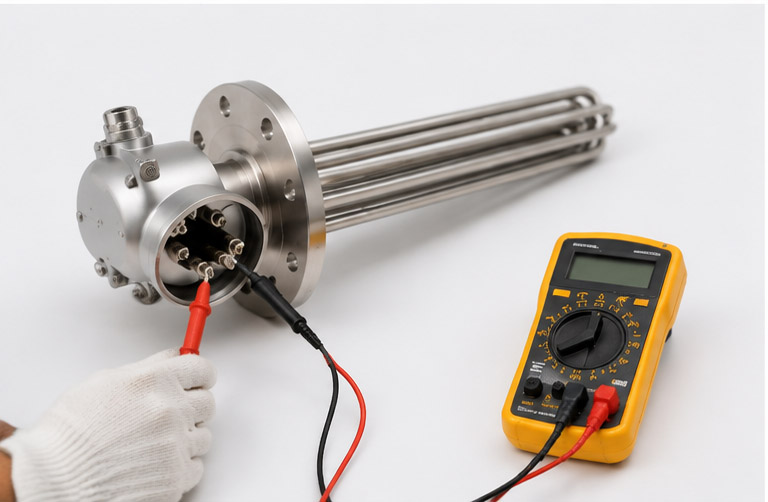
- Electrical basics: Proper grounding and correctly rated cabling are mandatory.
Step 7: Safety Standards and Certifications
Certifications determine whether the heater can legally and safely run in your region:
- UL / CSA: For North America.
- CE marking: For the EU (Low Voltage and EMC directives).
- Explosion-proof ratings: IEC 60079, ATEX, or Class I Div 1/2 for hazardous areas with flammable vapors (common in oil/chemical tanks).
- RoHS / REACH: Material and chemical compliance for the EU.
Step 8: Plan for Maintenance Before You Buy
- Descaling: In hard-water areas, budget for citric/acetic acid baths or chemical cleaning every few months.
- Fluid levels: Keep the fluid level above the element at all times using flow/level interlocks.
- Spares: For flanged heaters, keep a spare element on hand to reduce downtime to minutes instead of days.
Frequently Asked Questions
What is the difference between a screw plug and a flanged immersion heater? A screw plug heater threads into a standard port and suits smaller, lower-power tanks. A flanged heater bolts onto a companion flange and carries many elements, delivering much higher power and allowing individual element replacement.
Which sheath material should I choose? Match it to the fluid: SS304 for clean water, SS316/316L for hard water/chlorides, Incoloy for oils/high temperatures, and titanium or PTFE for aggressive chemicals.
What happens if the watt density is too high? The sheath surface temperature climbs above safe limits, accelerating scaling on water or coking on oils. This insulating layer drives the element hotter until it fails early.
How do I calculate the kW I need? For water: Power (kW) = (liters × temperature rise in °C × 4.18) ÷ (heating time in hours × 3,600), then add 15–20% for heat loss. Substitute the specific heat for oils/chemicals.
Can immersion heaters be used in hazardous areas? Yes, provided they are certified explosion-proof for the specific zone or division (e.g., ATEX, Class I Div 1/2) and match the temperature class of the flammable materials present.
How long does an industrial immersion heater last? A correctly matched, well-maintained heater in clean service typically runs for years. A mismatched one in hard water or heavy oil can fail within months.
Get the Specification Right with the Experts
Every tank is different, and the difference between a heater that lasts months and one that lasts years is usually in the specification details. Elekheat manufactures custom industrial immersion heaters—screw plug, flanged, over-the-side, and circulation types—engineered around your fluid, your power, and your certifications.
Send us your tank volume, fluid type, temperature rise, and target heat-up time, and our engineers will return a specification with the correct watt density, sheath material, and element layout.
Are there any specific fluid properties or tank dimensions you're working with right now that you'd like help sizing an element for?