 Skip to content

A cartridge heater fails prematurely more often from a watt-density mismatch than from a manufacturing defect. The heater itself may be perfectly built—correct diameter, correct voltage, correct sheath alloy—but if the power is packed into too little surface area for the medium it is heating, the internal resistance wire runs hotter than the application can absorb. Oxidation accelerates, the coil embrittles, and the heater opens. The same failure logic applies in reverse: specify watt density too conservatively, and the heater may never reach setpoint fast enough, forcing longer cycle times or a larger footprint than the machine can accommodate.
For B2B engineers and procurement teams, the high-density vs. low-density decision is therefore not a binary “premium vs. economy” choice. It is a thermal-engineering decision that starts with one number: watt density.
What Watt Density Actually Measures
Watt density is the electrical power dissipated per unit of active heated surface area—the zone of the sheath that actually generates heat, excluding the unheated cold sections at the terminals. It is expressed in watts per square inch (W/in²) or watts per square centimeter (W/cm²).
For a cylindrical cartridge heater:
Watt Density = Total Wattage ÷ (π × Diameter × Heated Length)
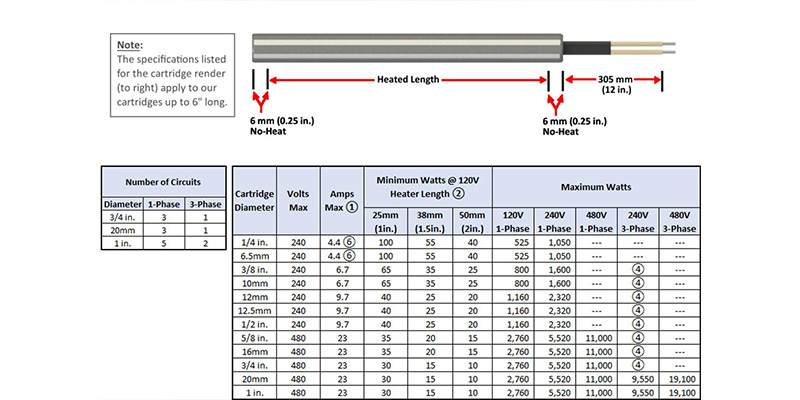
A 1,000 W heater with a 0.5 in. diameter and an 11.5 in. heated length produces approximately 55 W/in²—roughly 8.5 W/cm². That single number tells you more about how the heater will behave in service than wattage alone, because wattage says how much heat is available while watt density says how hard the heater has to work to deliver it.
For a reliable selection, calculate watt density using the actual heated length, not automatically the heater’s overall length. The unheated section varies with the heater design and termination. See the technical guidance from OMEGA Engineering and Chromalox.
High-Density vs. Low-Density: The Construction Difference Behind the Performance Difference
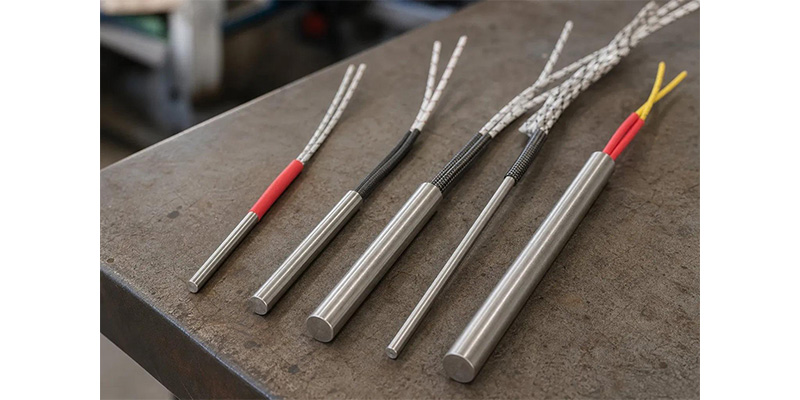
The density label describes both the internal build and the surface loading the heater is designed to sustain. Construction varies by manufacturer and product series, so watt-density rating and the manufacturer’s application limits should be checked alongside the construction type.
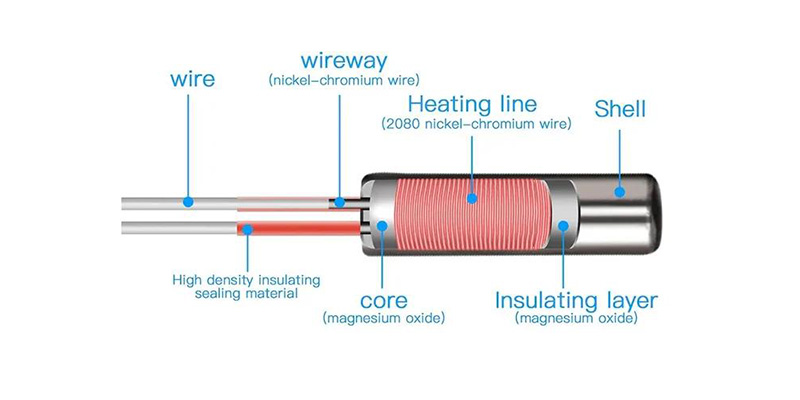
High-density cartridge heaters commonly use a swaged construction: high-purity magnesium oxide (MgO) powder is compacted under high pressure between the NiCr resistance coil and the sheath. Compaction improves heat transfer and dielectric performance, allowing more wattage to be packed into a smaller diameter when the heater is properly designed and installed. Some swaged designs can support watt densities around 50 W/cm² (approximately 323 W/in²), but the allowable value depends on heater dimensions, operating temperature, fit, sheath material, and the application.
Low-density cartridge heaters are often built using standard or non-swaged constructions, including designs with ceramic cores. The internal arrangement and insulation compaction differ by product, affecting heat transfer and the watt density the heater can sustain. These designs are commonly selected for lower-demand applications where space, temperature, and heat-up requirements allow a lower surface loading. The upfront cost may be lower for comparable standard designs, but any price difference depends on specifications and supplier.
A note on units: North American specifications commonly use W/in², while many international datasheets use W/cm². 1 W/cm² ≈ 6.45 W/in². Always confirm which unit a supplier is quoting before comparing “high” and “low” figures across sources.
Side-by-Side Comparison: What Changes When Density Changes
| Dimension | High-Density (often swaged) | Low-Density (often standard / non-swaged) |
|---|---|---|
| Heat-up speed | Can deliver high wattage from a compact footprint | May require more surface area or a longer heater to deliver the same wattage |
| Footprint for a given wattage | Compact designs are possible | More length or surface area may be needed, depending on the rating |
| Typical watt density ceiling | Some designs reach around 50 W/cm² (about 323 W/in²) or higher; check the specific product rating | Often designed for lower watt density; the allowable value is product- and application-specific |
| Sheath material demand | Alloy selection must account for sheath temperature, corrosion, and process conditions | Material selection must still account for temperature and chemical compatibility |
| Life expectancy under correct sizing | Can provide long service life when properly selected, installed, and controlled | Can provide suitable service life when matched to the application |
| Risk in viscous or scaling media | Excessive surface loading can cause coking or accelerate scale formation | Lower surface loading may be preferable where the medium is heat-sensitive |
| Relative upfront cost | May cost more depending on construction and specification | May cost less in comparable applications; obtain quotes for the actual specification |
| Best-fit applications | Compact tooling, injection molds, die heating, and other applications requiring high output from limited space | Lower-demand heating, larger available installation space, or applications where lower surface loading is needed |
The comparison table is a starting point, not a verdict. The decisive variable is the medium’s ability to absorb heat at the sheath surface, together with operating temperature, installation fit, and the heater’s construction.
The Medium Determines the Ceiling, Not the Heater Catalog
Watt density limits are not universal constants. They are functions of how quickly the surrounding material can pull heat away from the sheath. The following ranges are illustrative starting points only, not universal design limits or a substitute for a manufacturer’s watt-density chart. Actual allowable watt density must be confirmed for the heater construction, medium, flow conditions, operating temperature, sheath material, and installation.
| Medium | Illustrative watt density range | Why |
|---|---|---|
| Clean water | Application-specific; some flowing-water designs permit relatively high surface loading | Water can absorb heat effectively, but flow rate, local boiling risk, and sheath temperature still matter |
| Hard water / mineral solutions | Often requires a more conservative surface loading | High sheath temperature can accelerate mineral scaling; scale insulates and overheats the sheath |
| Light machine oils | Usually requires lower surface loading than clean water | Low thermal conductivity and oil degradation limits can make excessive surface temperature cause coking |
| Heavy fuel oil, asphalt, molasses | Often requires a low surface loading | Poor heat transfer and temperature-sensitive material can lead to carbonization |
| Static air | Requires application-specific calculation and may benefit from finned elements | Air transfers heat less effectively than liquids, so sheath temperature can rise quickly |
| Flowing air (high velocity) | Depends on air velocity, inlet temperature, and required outlet temperature | Continuous airflow can remove heat from the sheath, but the actual rating must be calculated |
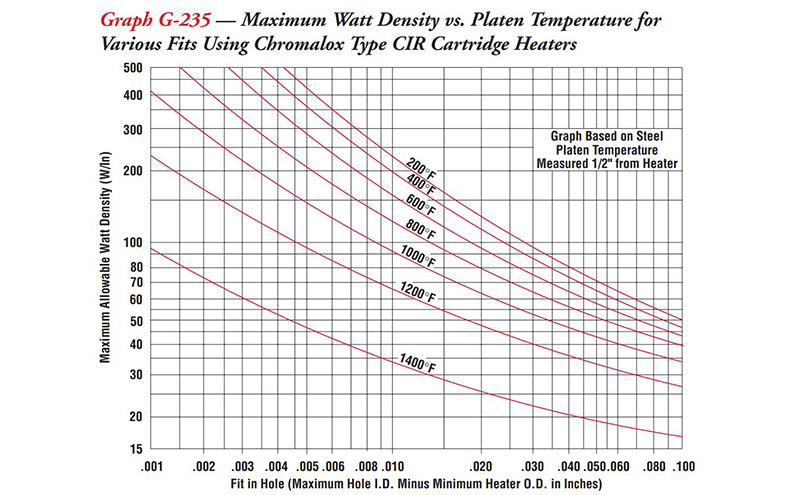
A high-density heater can be the correct choice when the medium can absorb concentrated heat—such as a metal mold block with a properly maintained fit, or a liquid or gas application specifically designed for that heater. A lower-watt-density design can be preferable when the medium cannot tolerate a hot sheath—such as viscous oils, heat-sensitive materials, or fluids prone to coking or scaling.
For a product-specific assessment, compare the application with the manufacturer’s technical guidance, such as OMEGA’s cartridge-heater recommendations and Chromalox’s cartridge-heater application guidelines.
Selection Framework: Five Questions That Resolve the Decision
1. What is the medium, and what is its degradation temperature?
If the medium degrades, cokes, or scales when the sheath exceeds a threshold, the sheath temperature—not the heater’s internal wire temperature—becomes the binding constraint. High watt density can increase sheath temperature; a lower watt density may help keep it within the application’s limits.
2. How fast does the process need to reach setpoint?
High-density heaters can solve a space-and-time problem: deliver a large wattage from a small insertion footprint, quickly. If warm-up time is not critical and the bore can accommodate a longer or larger-diameter heater, a lower-watt-density design may meet the thermal requirement at a lower cost.
3. What is the bore fit, and can it be maintained?
High-density performance in metal blocks depends on effective heat transfer between the sheath and the bore. A loose fit creates an air gap that acts as a thermal resistor, reducing heat transfer and potentially driving the heater’s internal temperature higher. If the bore cannot be machined to a consistent fit—or if field replacement with worn tooling is expected—a high-density heater may underperform its rating. The allowable fit should be checked against the specific heater manufacturer’s guidance; there is no single clearance suitable for every heater, temperature, and watt density.
4. Is the duty cycle continuous or intermittent?
Continuous industrial service requires a construction that can withstand the application’s operating temperature, thermal cycling, vibration, and control conditions. Swaged construction can improve heat transfer and support higher watt densities, but it does not automatically guarantee longer service life. A standard or lower-watt-density heater may be suitable for occasional use or lower-demand duties when its specifications match the application.
5. Does the sheath alloy match the surface temperature the watt density creates?
High watt density can raise sheath temperature even when the bulk medium is cooler. Incoloy and higher-grade stainless steels may be specified to address elevated temperature, oxidation, or corrosion, depending on the application. The correct sheath material must be selected according to both operating temperature and the chemical environment; a higher alloy alone cannot compensate for an unsuitable watt density or poor installation fit.
A Worked Sizing Example
A mold block requires 1,200 W of installed heating capacity. Bore diameter is fixed at 0.5 in. due to tooling constraints.
Option A: one high-density heater.
Heated length: 6 in. Surface area = π × 0.5 × 6 = 9.42 in². Watt density = 1,200 ÷ 9.42 ≈ 127 W/in² (≈19.7 W/cm²).
This calculation gives the nominal watt density only. Whether it is allowable at a mold operating temperature of 500°F depends on the specific heater’s watt-density chart, the mold material, the actual bore fit, the sheath alloy, and the temperature inside the heater. The same nominal watt density may be unsuitable under a higher operating temperature or a looser fit.
Option B: two lower-watt-density heaters.
Two 600 W heaters, each with a 0.5 in. diameter and 6 in. heated length, produce approximately 64 W/in² each. The lower surface loading may reduce thermal stress if the heaters are properly positioned and the heat can transfer effectively into the mold. The trade-offs include a second heater, additional wiring, and possible changes to temperature control and heat distribution.
Neither option is universally “correct.” The decision depends on the allowable watt density for the specific mold material, operating temperature, heater construction, and fit—which is exactly why a catalog value alone cannot resolve the specification.
When High Density Is the Right Investment
High-density cartridge heaters are worth evaluating when at least two of the following are true:
- Insertion space is constrained by tooling geometry, and the required wattage cannot be spread over a longer or larger element.
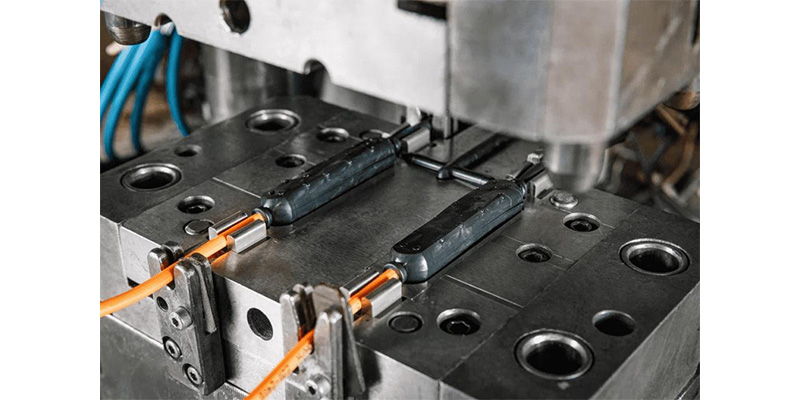
- Heat-up time directly gates throughput—fast-cycling injection molds, hot runner systems, die casting, or sealing bars where recovery speed affects cycle time.
- The application can remove heat effectively—for example, a metal mass with a suitable, maintained bore fit.
- The sheath alloy can be selected for the operating conditions without compromising the economics of the tool.
When Low Density Is the Engineering-Correct Choice, Not a Compromise
Low-density heaters are frequently mislabeled as “economy” solutions. In several scenarios, a lower-watt-density design may be technically preferable:
- Viscous or degradable fluids: oils, asphalt, heavy chemicals, and food products that coke or scorch when surface temperature exceeds a threshold.
- Hard water or scaling service: lower sheath temperature may reduce the tendency for mineral deposition.
- Long, low-temperature platens or tanks where installation space is available and warm-up time is not throughput-critical.
- Intermittent or low-demand equipment where a standard construction meets the required service conditions and budget.
The mistake is not choosing low density. The mistake is choosing a heater because it is cheaper without verifying that its watt-density rating is suitable for the application. If the required wattage divided by available heated surface area exceeds the heater’s allowable rating, the initial saving may be offset by early failure or poor performance.
Matching ELEKHEAT Products to the Decision
ELEKHEAT manufactures cartridge heaters for OEM and industrial applications, with customization across diameter, heated length, voltage, sheath alloy, lead configuration, and built-in thermocouple options. Available watt density and construction should be confirmed against the selected model and application requirements.
High-density cartridge heaters can be specified for compact heating applications such as injection molding, packaging sealing, and precision heating blocks. Incoloy sheaths and other material options should be selected according to operating temperature and the application’s chemical and thermal conditions. Any maximum watt-density claim, including ratings of 300 W/in² or higher, should be confirmed against the exact ELEKHEAT product specification before publication or quotation.
Low-watt-density cartridge heaters can be considered for applications where the medium’s heat-transfer capacity, not the heater’s maximum rating, sets the limit—such as oil and viscous-fluid heating, storage tanks, and sensitive-process equipment. The final selection should be based on the actual medium, operating temperature, installation, and required heat-up time.
If you are uncertain which density class fits your bore, medium, and duty cycle, share the application parameters with ELEKHEAT’s engineering team for a watt-density calculation and a sizing recommendation.
→ Request a cartridge heater quote or engineering review at ELEKHEAT.
Frequently Asked Questions
How do I calculate cartridge heater watt density?
Divide the heater’s wattage by its active heated surface area. For a cylindrical cartridge heater, use: watt density = wattage ÷ (π × diameter × heated length). Use the actual heated length and exclude unheated cold sections.
Is a higher watt density always better?
No. A higher watt density can provide more heat from a compact heater, but it can also increase internal and sheath temperatures. The allowable value depends on the heater design, operating temperature, fit, sheath material, and the medium being heated.
Do high-density cartridge heaters last longer than low-density heaters?
Not automatically. Service life depends on correct watt-density selection, heat transfer, installation fit, temperature, control strategy, and the operating environment. A properly selected lower-watt-density heater can be the better choice for a particular application.
What information is needed to select a cartridge heater?
Provide the required wattage and voltage, heater diameter and overall or heated length, medium or material being heated, operating temperature, duty cycle, bore dimensions and tolerances (for mold applications), sheath material requirements, lead or terminal configuration, and any built-in thermocouple requirements.
Can ELEKHEAT customize cartridge heaters?
ELEKHEAT offers customization options such as dimensions, voltage, wattage, sheath material, lead configuration, and thermocouple options, subject to engineering review. Contact ELEKHEAT with your drawing or application parameters to confirm feasibility.
